

 ENG
ENG- KI-Beschleunigung
- Branchen
- Finanzen
Nearshore-Softwareentwicklung für den Finanzsektor – sicher, skalierbar und Compliance-gerechte Lösungen für Banking, Zahlungsverkehr und APIs.
- Einzelhandel
Softwareentwicklung für den Einzelhandel – E-Commerce, Kassensysteme, Logistik und KI-gestützte Personalisierung durch unsere Nearshore-Engineering-Teams.
- Verarbeitende Industrie
Nearshore-Softwareentwicklung für die Industrie – ERP-Systeme, IoT-Plattformen und Automatisierungstools zur Optimierung industrieller Abläufe.
- Finanzen
- Was wir tun
- Dienstleistungen
- Technologien
- Collaboration models
- Kooperationsmodelle
Kooperationsmodelle passend zu Ihren Bedürfnissen: Komplette Nearshoring Teams, deutschsprachige Experten vor Ort mit Nearshoring-Teams oder gemischte Teams mit unseren Partnern.
- Arbeitsweise
Durch enge Zusammenarbeit mit Ihrem Unternehmen schaffen wir maßgeschneiderte Lösungen, die auf Ihre Anforderungen abgestimmt sind und zu nachhaltigen Ergebnissen führen.
- Kooperationsmodelle
- Über uns
- Wer wir sind
Wir sind ein Full-Service Nearshoring-Anbieter für digitale Softwareprodukte, ein perfekter Partner mit deutschsprachigen Experten vor Ort, Ihre Business-Anforderungen stets im Blick
- Unser Team
Das ProductDock Team ist mit modernen Technologien und Tools vertraut und setzt seit 15 Jahren zusammen mit namhaften Firmen erfolgreiche Projekte um.
- Wozu Nearshoring
Wir kombinieren Nearshore- und Fachwissen vor Ort, um Sie während Ihrer gesamten digitalen Produktreise optimal zu unterstützen. Lassen Sie uns Ihr Business gemeinsam auf das nächste digitale Level anheben.
- Wer wir sind
- Unser Leistungen
- Karriere
- Arbeiten bei ProductDock
Unser Fokus liegt auf der Förderung von Teamarbeit, Kreativität und Empowerment innerhalb unseres Teams von über 120 talentierten Tech-Experten.
- Offene Stellen
Begeistert es dich, an spannenden Projekten mitzuwirken und zu sehen, wie dein Einsatz zu erfolgreichen Ergebnissen führt? Dann bist du bei uns richtig.
- Info Guide für Kandidaten
Wie suchen wir unsere Crew-Mitglieder aus? Wir sehen dich als Teil unserer Crew und erklären gerne unseren Auswahlprozess.
- Praktikum im Anfänger-Bootcamp
Starte deine IT-Karriere mit dem Rookie Boot Camp, unserem bezahlten Praktikumsprogramm, in dem Studenten und Absolventen Fähigkeiten aufbauen, Selbstvertrauen gewinnen und praktische Erfahrungen sammeln.
- Arbeiten bei ProductDock
- Newsroom
- News
Folgen Sie unseren neuesten Updates und Veröffentlichungen, damit Sie stets über die aktuellsten Entwicklungen von ProductDock informiert sind.
- Events
Vertiefen Sie Ihr Wissen, indem Sie sich mit Gleichgesinnten vernetzen und an unseren nächsten Veranstaltungen Erfahrungen mit Experten austauschen.
- News
- Blog
- Kontakt

14. Mai 2026 •3 minutes read
Azure AI search deep dive: From SQL queries to AI-powered retrieval
Nemanja Marić
Software Engineer
This article is the first part of the Search Trilogy, a series comparing three major enterprise search platforms: Azure AI Search, Apache Solr, and Elasticsearch.
In this installment, we focus on Azure AI Search, Microsoft’s fully managed search service that combines traditional inverted-index search with AI enrichment and vector-based retrieval.
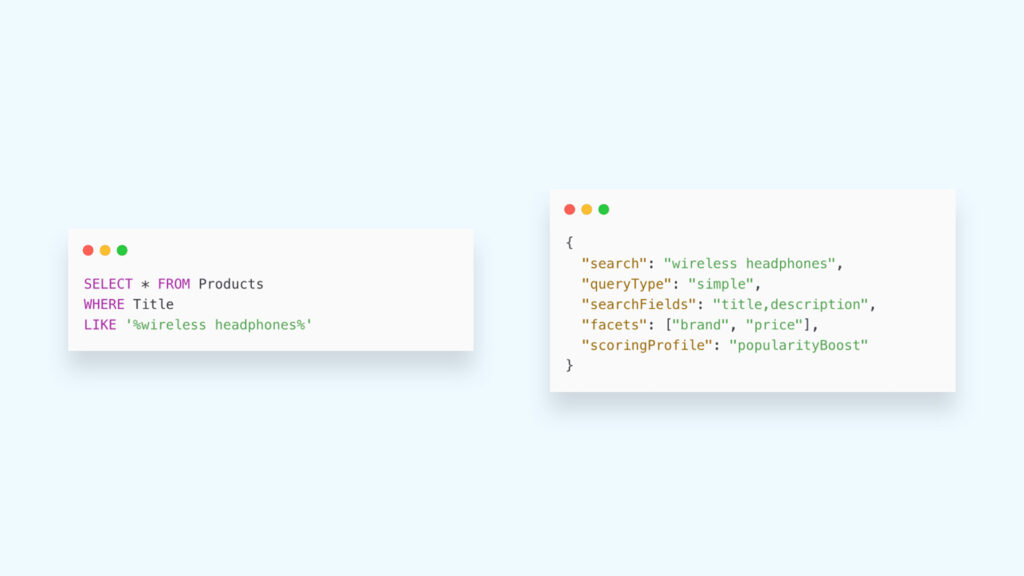
Limitations of traditional SQL search
SQL-based search is fundamentally limited to exact or pattern-based matching. It lacks:
- Relevance ranking based on scoring models
- Linguistic processing (stemming, synonyms)
- Autocomplete and suggestion capabilities
- Semantic understanding of queries
As a result, SQL queries return correct results but not necessarily relevant ones, especially for large or unstructured datasets.
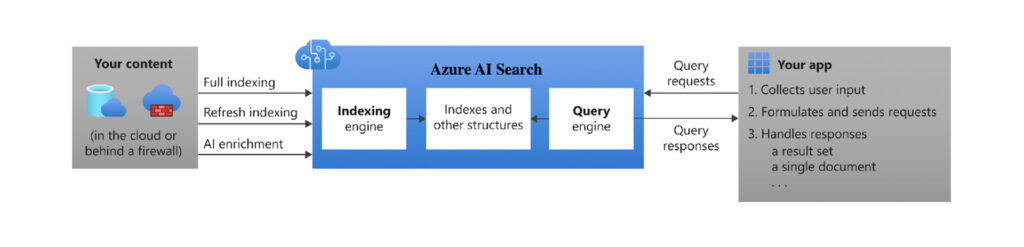
Azure AI search architecture overview
Azure AI Search introduces a decoupled architecture where search is performed on a precomputed index rather than directly on the data source.
The system acts as an intermediary between:
- External data stores (unindexed raw data)
- Client applications (query execution and result consumption)
This separation enables optimized query performance, advanced ranking, and AI-driven enrichment.
Core components
Data source
Data source defines the origin of the data (Azure SQL, Blob Storage, Cosmos DB, etc.).Important: Azure AI Search does not query the data source at runtime—all queries are executed against the index.
Index
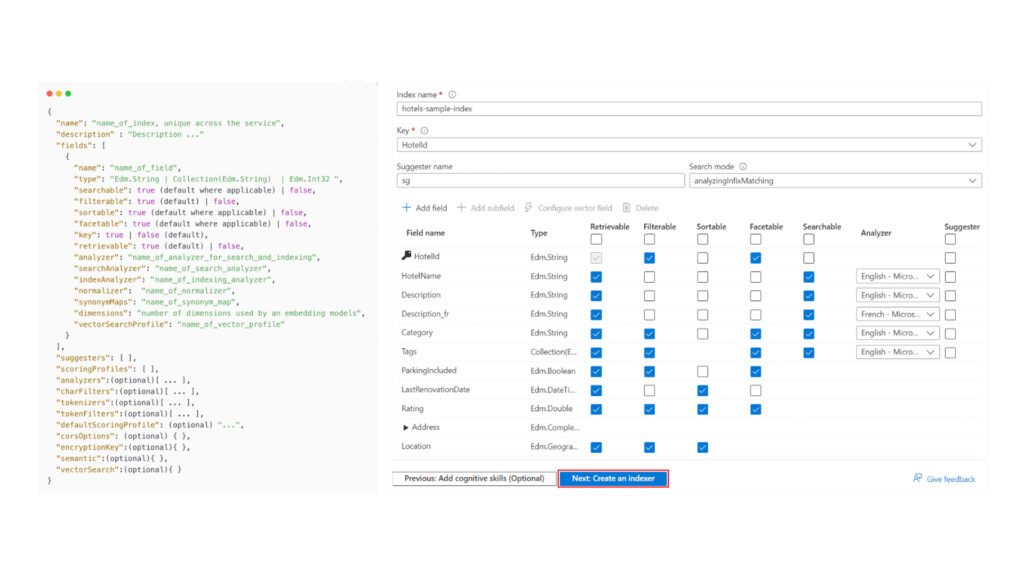
The central data structure is similar to a search-optimized schema.
Each index:
- Has a defined schema
- Contains fields with attributes such as:
- searchable
- filterable
- sortable
- facetable
- retrievable
Proper field configuration is critical for query performance and flexibility.
Document
Represents the atomic unit of search.
- Equivalent to a JSON object
- Contains fields defined in the index schema
- Must include a unique key
Documents are ingested into the index via push or pull mechanisms.
{
  "productId": "p001",
  "name": "Wireless Bluetooth Headphones",
  "description": "High-quality noise-cancelling headphones with long battery life.",
  "price": 199.99,
  "category": ["Audio", "Headphones"],
  "rating": 4.5
}
Indexer (pull model)
A scheduled crawler that:
- Extracts data from the data source
- Maps fields to the index schema
- Populates the index
Each indexer maintains a 1:1 relationship with a data source and index.
Push model (custom ingestion)
Data is explicitly pushed to the index via:
- REST API
- SDKs (Java, Python, C#, etc.)
This approach allows integration with non-Azure data sources or custom pipelines.
{
  "name": "(required) String that uniquely identifies the indexer",
  "description": "(optional)",
  "dataSourceName": "(required) String indicating which existing data source to use",
  "targetIndexName": "(required) String indicating which existing index to use",
  "parameters": {
    "batchSize": null,
    "maxFailedItems": 0,
    "maxFailedItemsPerBatch": 0,
    "base64EncodeKeys": false,
    "configuration": {}
  },
  "fieldMappings": "(optional) unless field discrepancies need resolution",
  "disabled": null,
  "schedule": null,
  "encryptionKey": null
}
Skillsets (AI enrichment pipeline)
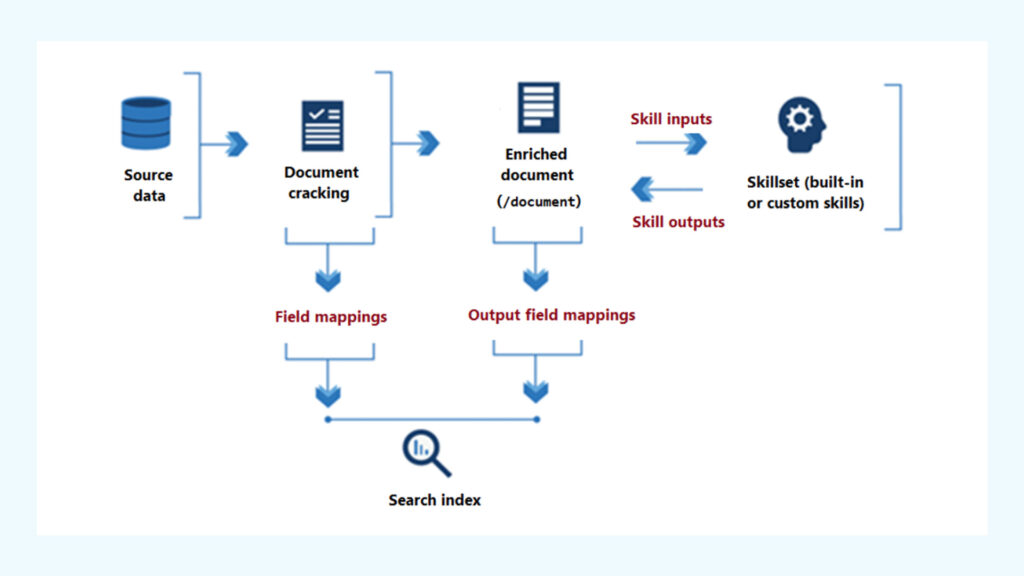
Skillsets define a pipeline of cognitive transformations applied during indexing.
Common capabilities:
- OCR for text extraction from images/PDFs
- Language detection and translation
- Key phrase extraction
- Entity recognition
Skillsets operate before data is indexed, enriching documents with additional searchable metadata.
Query layer
Azure AI Search supports multiple query paradigms:
- Full-text search (Lucene-based, fuzzy, autocomplete)
- Vector search (embedding-based similarity search)
- Hybrid search (combining lexical + vector queries)
Query execution includes:
- Scoring and ranking
- Filtering ($filter)
- Sorting ($orderby)
- Faceting
{
  "method": "POST",
  "url": "/indexes/products/docs/search?api-version=2023-07-01",
  "body": {
    "search": "wireless headphones",
    "filter": "brand eq 'Sony'",
    "top": 5
  }
}
Infrastructure as code considerations
Azure AI Search has partial Terraform support:
Supported:
azurerm_search_service (search service provisioning)
Not supported:
- Indexes
- Indexers
- Skillsets
These must be created via:
- REST API
- Azure SDKs
This introduces a hybrid provisioning model in which IaC handles infrastructure, while application-level configuration is API-driven.
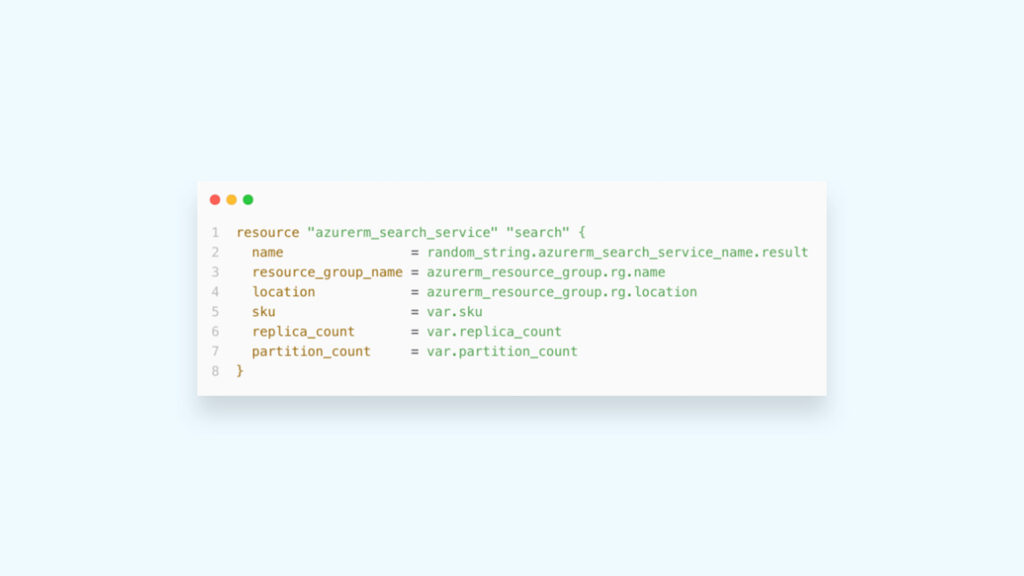
resource "azurerm_search_service" "example" {
  name                = "my-search-service"
  resource_group_name = "rg-example"
  location            = "West Europe"
  sku                 = "standard"
}
Retrieval-augmented generation (RAG)
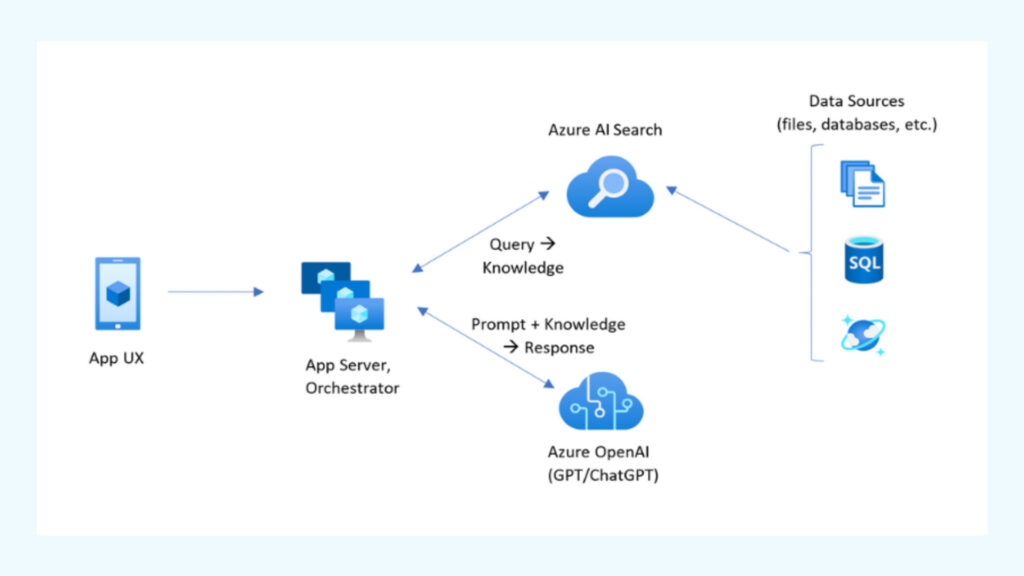
Azure AI Search integrates directly into RAG architectures.
Typical flow:
- User submits a natural language query
- Search service retrieves relevant documents (keyword, vector, or hybrid)
- Results are passed to an LLM (e.g., Azure OpenAI)
- The model generates a grounded response
This approach improves:
- Accuracy
- Context awareness
- Explainability of AI outputs
Practical use cases
Azure AI Search is particularly effective in scenarios involving:
- Large-scale document search (PDFs, knowledge bases)
- E-commerce product discovery (faceted filtering, ranking)
- AI assistants with contextual retrieval
- Enterprise search across heterogeneous data sources
Conclusion
Azure AI Search provides a search-first architecture that separates data storage from retrieval, enabling scalable, performant, and intelligent search experiences.
Key strengths:
- Precomputed indexing for performance
- AI enrichment for unstructured data
- Hybrid search (lexical + vector)
- Integration with generative AI (RAG)
In the next part of the Search Trilogy, we will analyze Apache Solr, focusing on its flexibility, configuration model, and on-premise capabilities.
Tags:Skip tags

Nemanja Marić
Software EngineerNemanja Marić is a software engineer with 6 years of hands-on experience in building robust and scalable applications. He holds a BSc in Software Engineering and specializes primarily in Java and Spring. Along the way, he had also explored C#, React, Cloud Computing, and Flutter. He approaches software development with genuine joy and a passion for creating impactful solutions by building scalable, robust, and high-quality software.
Related posts.

KI
Can AI tell you whether a frozen project is actually safe to turn back on?
Bruno Raljić• 22. Okt. 2026
Find out more
Digital solutions, Integration, KI
Two systems, one number, and no rule that gets it right
Danijel Dragičević• 08. Okt. 2026
Find out more
KI
Can AI recover project knowledge that only ever lived in one person’s head?
Bruno Raljić• 01. Okt. 2026
Find out more