

 DE
DE- AI acceleration
- Industries
- Finance
Nearshore software development for finance—secure, scalable, and compliant solutions for banking, payments, and APIs.
- Retail
Retail software development services—e-commerce, POS, logistics, and AI-driven personalization from nearshore engineering teams.
- Manufacturing
Nearshore manufacturing software development—ERP systems, IoT platforms, and automation tools to optimize industrial operations.
- Finance
- What we do
- Services
- Software modernization services
- Cloud solutions
- AI – Artificial intelligence
- Idea validation & Product development services
- Digital solutions
- Integrations for digital ecosystems
- A11y – Accessibility
- QA – Test development
- Technologies
- Front-end
- Back-end
- DevOps & CI/CD
- Cloud
- Mobile
- Collaboration models
- Collaboration models
Explore collaboration models customized to your specific needs: Complete nearshoring teams, Local heroes from partners with the nearshoring team, or Mixed tech teams with partners.
- Way of work
Through close collaboration with your business, we create customized solutions aligned with your specific requirements, resulting in sustainable outcomes.
- Collaboration models
- Services
- About Us
- Who we are
We are a full-service nearshoring provider for digital software products, uniquely positioned as a high-quality partner with native-speaking local experts, perfectly aligned with your business needs.
- Meet our team
ProductDock’s experienced team proficient in modern technologies and tools, boasts 15 years of successful projects, collaborating with prominent companies.
- Why nearshoring
Elevate your business efficiently with our premium full-service software development services that blend nearshore and local expertise to support you throughout your digital product journey.
- Who we are
- Our work
- Career
- Life at ProductDock
We’re all about fostering teamwork, creativity, and empowerment within our team of over 120 incredibly talented experts in modern technologies.
- Open positions
Do you enjoy working on exciting projects and feel rewarded when those efforts are successful? If so, we’d like you to join our team.
- Hiring guide
How we choose our crew members? We think of you as a member of our crew. We are happy to share our process with you!
- Rookie boot camp internship
Start your IT journey with Rookie boot camp, our paid internship program where students and graduates build skills, gain confidence, and get real-world experience.
- Life at ProductDock
- Newsroom
- News
Stay engaged with our most recent updates and releases, ensuring you are always up-to-date with the latest developments in the dynamic world of ProductDock.
- Events
Expand your expertise through networking with like-minded individuals and engaging in knowledge-sharing sessions at our upcoming events.
- News
- Blog
- Get in touch

14. May 2026 •3 minutes read
Azure AI search deep dive: From SQL queries to AI-powered retrieval
Nemanja Marić
Software Engineer
This article is the first part of the Search Trilogy, a series comparing three major enterprise search platforms: Azure AI Search, Apache Solr, and Elasticsearch.
In this installment, we focus on Azure AI Search, Microsoft’s fully managed search service that combines traditional inverted-index search with AI enrichment and vector-based retrieval.
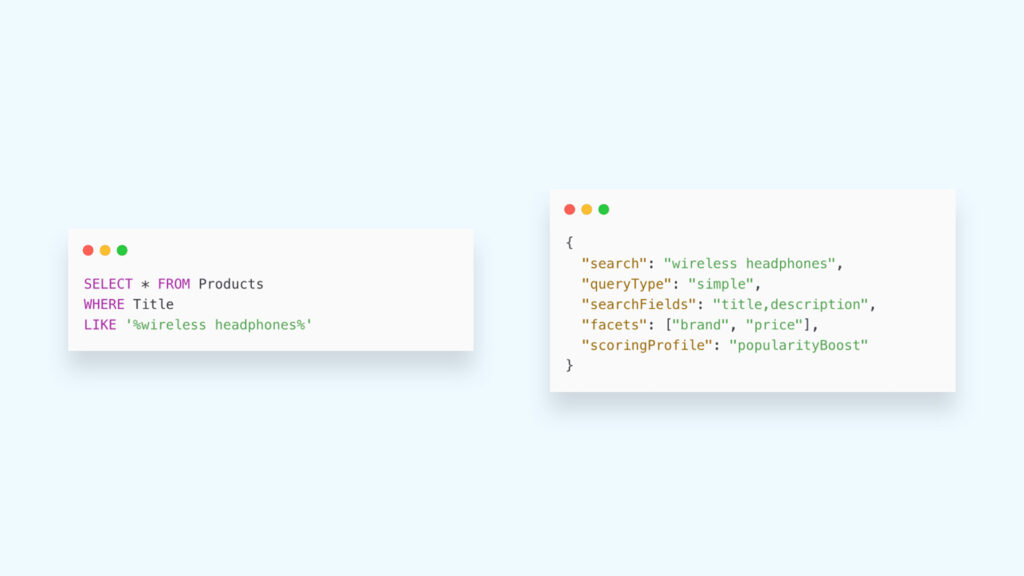
Limitations of traditional SQL search
SQL-based search is fundamentally limited to exact or pattern-based matching. It lacks:
- Relevance ranking based on scoring models
- Linguistic processing (stemming, synonyms)
- Autocomplete and suggestion capabilities
- Semantic understanding of queries
As a result, SQL queries return correct results but not necessarily relevant ones, especially for large or unstructured datasets.
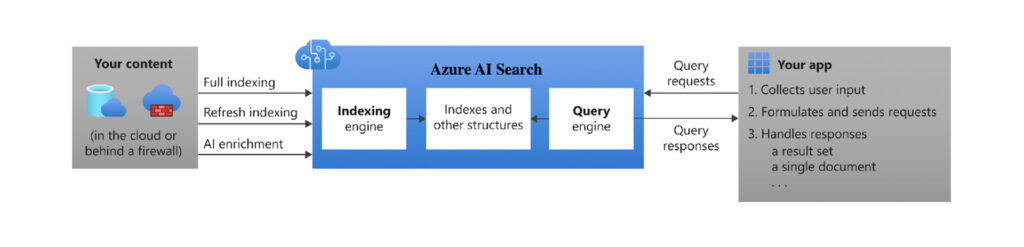
Azure AI search architecture overview
Azure AI Search introduces a decoupled architecture where search is performed on a precomputed index rather than directly on the data source.
The system acts as an intermediary between:
- External data stores (unindexed raw data)
- Client applications (query execution and result consumption)
This separation enables optimized query performance, advanced ranking, and AI-driven enrichment.
Core components
Data source
Data source defines the origin of the data (Azure SQL, Blob Storage, Cosmos DB, etc.).Important: Azure AI Search does not query the data source at runtime—all queries are executed against the index.
Index
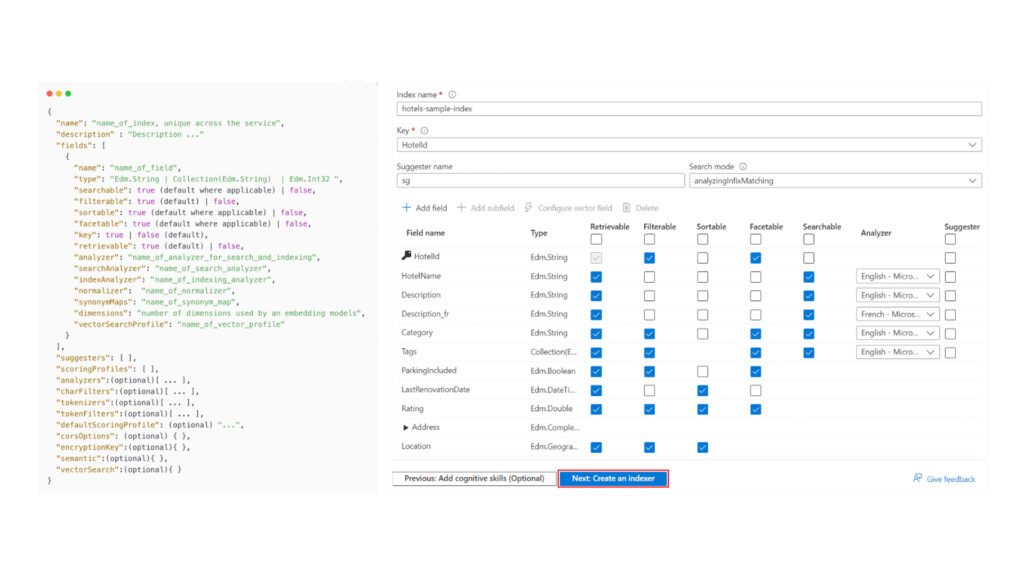
The central data structure is similar to a search-optimized schema.
Each index:
- Has a defined schema
- Contains fields with attributes such as:
- searchable
- filterable
- sortable
- facetable
- retrievable
Proper field configuration is critical for query performance and flexibility.
Document
Represents the atomic unit of search.
- Equivalent to a JSON object
- Contains fields defined in the index schema
- Must include a unique key
Documents are ingested into the index via push or pull mechanisms.
{
  "productId": "p001",
  "name": "Wireless Bluetooth Headphones",
  "description": "High-quality noise-cancelling headphones with long battery life.",
  "price": 199.99,
  "category": ["Audio", "Headphones"],
  "rating": 4.5
}
Indexer (pull model)
A scheduled crawler that:
- Extracts data from the data source
- Maps fields to the index schema
- Populates the index
Each indexer maintains a 1:1 relationship with a data source and index.
Push model (custom ingestion)
Data is explicitly pushed to the index via:
- REST API
- SDKs (Java, Python, C#, etc.)
This approach allows integration with non-Azure data sources or custom pipelines.
{
  "name": "(required) String that uniquely identifies the indexer",
  "description": "(optional)",
  "dataSourceName": "(required) String indicating which existing data source to use",
  "targetIndexName": "(required) String indicating which existing index to use",
  "parameters": {
    "batchSize": null,
    "maxFailedItems": 0,
    "maxFailedItemsPerBatch": 0,
    "base64EncodeKeys": false,
    "configuration": {}
  },
  "fieldMappings": "(optional) unless field discrepancies need resolution",
  "disabled": null,
  "schedule": null,
  "encryptionKey": null
}
Skillsets (AI enrichment pipeline)
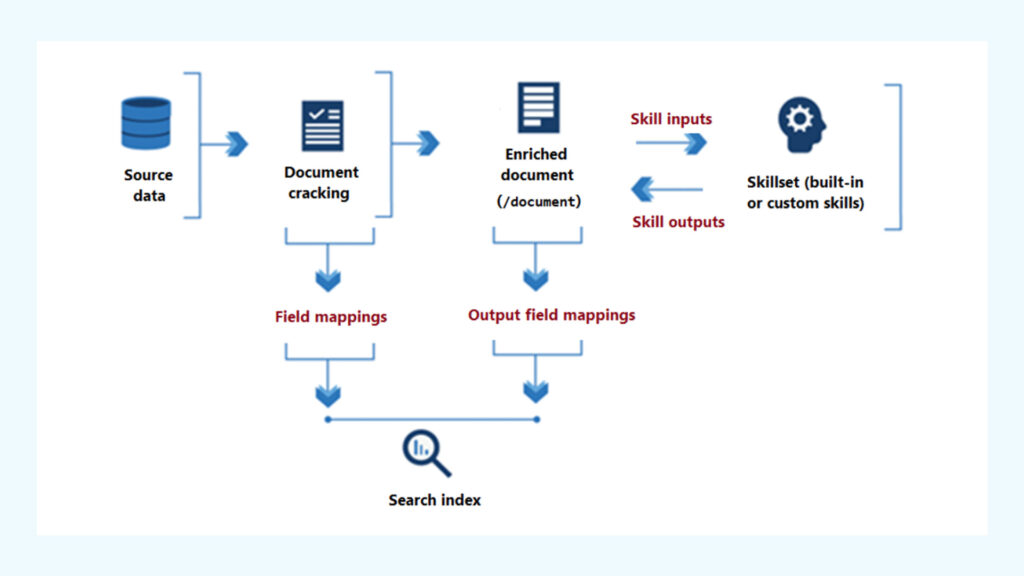
Skillsets define a pipeline of cognitive transformations applied during indexing.
Common capabilities:
- OCR for text extraction from images/PDFs
- Language detection and translation
- Key phrase extraction
- Entity recognition
Skillsets operate before data is indexed, enriching documents with additional searchable metadata.
Query layer
Azure AI Search supports multiple query paradigms:
- Full-text search (Lucene-based, fuzzy, autocomplete)
- Vector search (embedding-based similarity search)
- Hybrid search (combining lexical + vector queries)
Query execution includes:
- Scoring and ranking
- Filtering ($filter)
- Sorting ($orderby)
- Faceting
{
  "method": "POST",
  "url": "/indexes/products/docs/search?api-version=2023-07-01",
  "body": {
    "search": "wireless headphones",
    "filter": "brand eq 'Sony'",
    "top": 5
  }
}
Infrastructure as code considerations
Azure AI Search has partial Terraform support:
Supported:
azurerm_search_service (search service provisioning)
Not supported:
- Indexes
- Indexers
- Skillsets
These must be created via:
- REST API
- Azure SDKs
This introduces a hybrid provisioning model in which IaC handles infrastructure, while application-level configuration is API-driven.
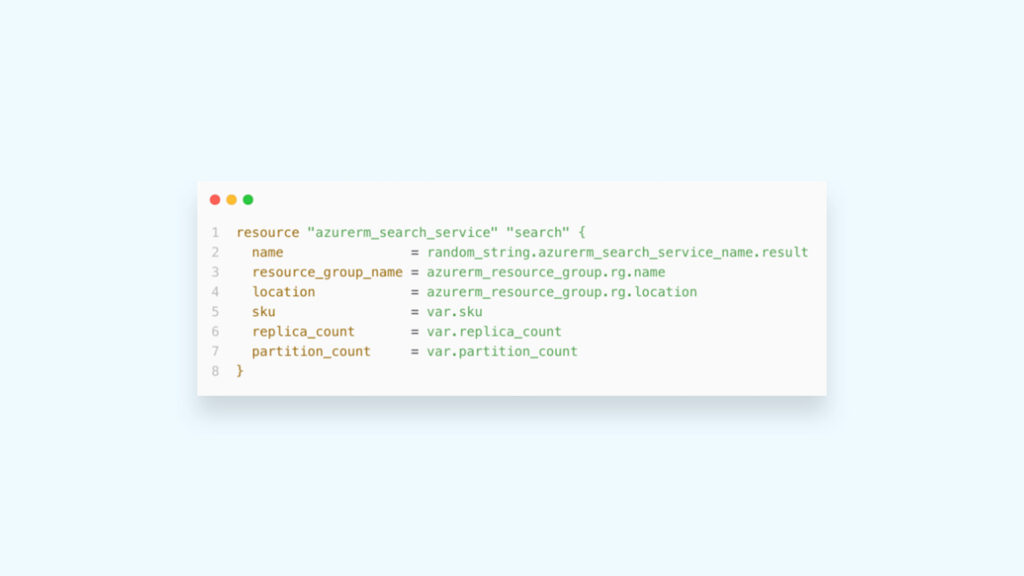
resource "azurerm_search_service" "example" {
  name                = "my-search-service"
  resource_group_name = "rg-example"
  location            = "West Europe"
  sku                 = "standard"
}
Retrieval-augmented generation (RAG)
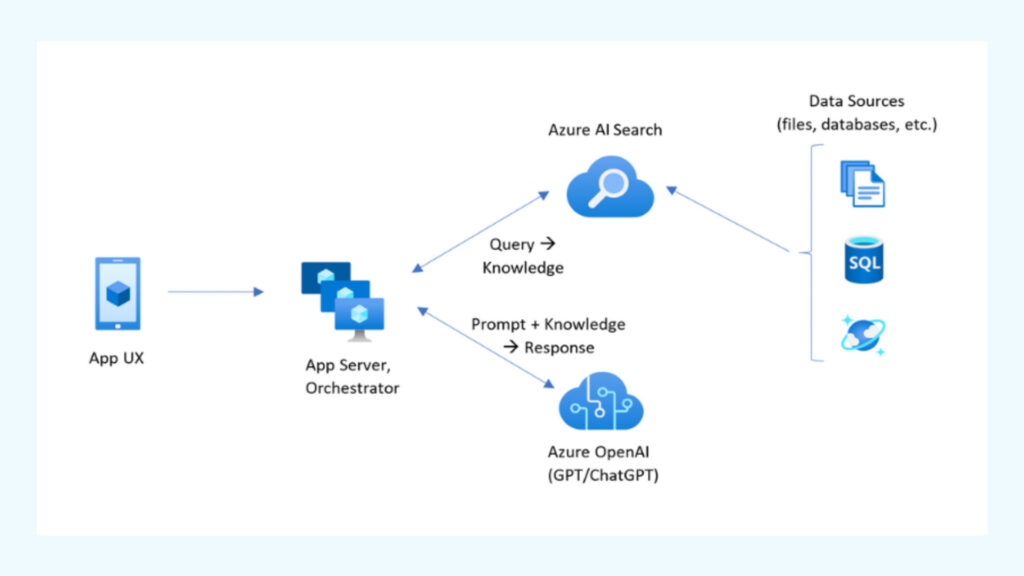
Azure AI Search integrates directly into RAG architectures.
Typical flow:
- User submits a natural language query
- Search service retrieves relevant documents (keyword, vector, or hybrid)
- Results are passed to an LLM (e.g., Azure OpenAI)
- The model generates a grounded response
This approach improves:
- Accuracy
- Context awareness
- Explainability of AI outputs
Practical use cases
Azure AI Search is particularly effective in scenarios involving:
- Large-scale document search (PDFs, knowledge bases)
- E-commerce product discovery (faceted filtering, ranking)
- AI assistants with contextual retrieval
- Enterprise search across heterogeneous data sources
Conclusion
Azure AI Search provides a search-first architecture that separates data storage from retrieval, enabling scalable, performant, and intelligent search experiences.
Key strengths:
- Precomputed indexing for performance
- AI enrichment for unstructured data
- Hybrid search (lexical + vector)
- Integration with generative AI (RAG)
In the next part of the Search Trilogy, we will analyze Apache Solr, focusing on its flexibility, configuration model, and on-premise capabilities.
Ready to upgrade your legacy search to an AI-powered retrieval system?
Whether you are building advanced RAG (Retrieval-Augmented Generation) applications or transitioning from traditional SQL to vector search, explore our AI services to see how we design and deploy scalable, intelligent data architectures.
Tags:Skip tags

Nemanja Marić
Software EngineerNemanja Marić is a software engineer with 6 years of hands-on experience in building robust and scalable applications. He holds a BSc in Software Engineering and specializes primarily in Java and Spring. Along the way, he had also explored C#, React, Cloud Computing, and Flutter. He approaches software development with genuine joy and a passion for creating impactful solutions by building scalable, robust, and high-quality software.
Related posts.

AI
Can AI tell you whether a frozen project is actually safe to turn back on?
Bruno Raljić• 22. Oct 2026
Find out more
AI, Digital solutions, Integration
Two systems, one number, and no rule that gets it right
Danijel Dragičević• 08. Oct 2026
Find out more
AI
Can AI recover project knowledge that only ever lived in one person’s head?
Bruno Raljić• 01. Oct 2026
Find out more