

 ENG
ENG- KI-Beschleunigung
- Branchen
- Finanzen
Nearshore-Softwareentwicklung für den Finanzsektor – sicher, skalierbar und Compliance-gerechte Lösungen für Banking, Zahlungsverkehr und APIs.
- Einzelhandel
Softwareentwicklung für den Einzelhandel – E-Commerce, Kassensysteme, Logistik und KI-gestützte Personalisierung durch unsere Nearshore-Engineering-Teams.
- Verarbeitende Industrie
Nearshore-Softwareentwicklung für die Industrie – ERP-Systeme, IoT-Plattformen und Automatisierungstools zur Optimierung industrieller Abläufe.
- Finanzen
- Was wir tun
- Dienstleistungen
- Technologien
- Collaboration models
- Kooperationsmodelle
Kooperationsmodelle passend zu Ihren Bedürfnissen: Komplette Nearshoring Teams, deutschsprachige Experten vor Ort mit Nearshoring-Teams oder gemischte Teams mit unseren Partnern.
- Arbeitsweise
Durch enge Zusammenarbeit mit Ihrem Unternehmen schaffen wir maßgeschneiderte Lösungen, die auf Ihre Anforderungen abgestimmt sind und zu nachhaltigen Ergebnissen führen.
- Kooperationsmodelle
- Über uns
- Wer wir sind
Wir sind ein Full-Service Nearshoring-Anbieter für digitale Softwareprodukte, ein perfekter Partner mit deutschsprachigen Experten vor Ort, Ihre Business-Anforderungen stets im Blick
- Unser Team
Das ProductDock Team ist mit modernen Technologien und Tools vertraut und setzt seit 15 Jahren zusammen mit namhaften Firmen erfolgreiche Projekte um.
- Wozu Nearshoring
Wir kombinieren Nearshore- und Fachwissen vor Ort, um Sie während Ihrer gesamten digitalen Produktreise optimal zu unterstützen. Lassen Sie uns Ihr Business gemeinsam auf das nächste digitale Level anheben.
- Wer wir sind
- Unser Leistungen
- Karriere
- Arbeiten bei ProductDock
Unser Fokus liegt auf der Förderung von Teamarbeit, Kreativität und Empowerment innerhalb unseres Teams von über 120 talentierten Tech-Experten.
- Offene Stellen
Begeistert es dich, an spannenden Projekten mitzuwirken und zu sehen, wie dein Einsatz zu erfolgreichen Ergebnissen führt? Dann bist du bei uns richtig.
- Info Guide für Kandidaten
Wie suchen wir unsere Crew-Mitglieder aus? Wir sehen dich als Teil unserer Crew und erklären gerne unseren Auswahlprozess.
- Praktikum im Anfänger-Bootcamp
Starte deine IT-Karriere mit dem Rookie Boot Camp, unserem bezahlten Praktikumsprogramm, in dem Studenten und Absolventen Fähigkeiten aufbauen, Selbstvertrauen gewinnen und praktische Erfahrungen sammeln.
- Arbeiten bei ProductDock
- Newsroom
- News
Folgen Sie unseren neuesten Updates und Veröffentlichungen, damit Sie stets über die aktuellsten Entwicklungen von ProductDock informiert sind.
- Events
Vertiefen Sie Ihr Wissen, indem Sie sich mit Gleichgesinnten vernetzen und an unseren nächsten Veranstaltungen Erfahrungen mit Experten austauschen.
- News
- Blog
- Kontakt

10. Sep. 2026 •4 minutes read
Elasticsearch deep dive: From distributed search to the full power of the ELK stack
Nemanja Marić
Software Engineer
Following our deep dives into Azure AI Search (Part 1), and Apache Solr (Part 2), we now explore the industry heavyweight: Elasticsearch.
Built for unprecedented speed, massive scale, and modern AI applications, this open-source, distributed engine is the go-to solution for structured, unstructured, and vector data.
Let’s unpack how Elasticsearch works, why the ELK stack is a game-changer, and which platform ultimately claims the throne in our Trilogy Showdown.
What is Elasticsearch?
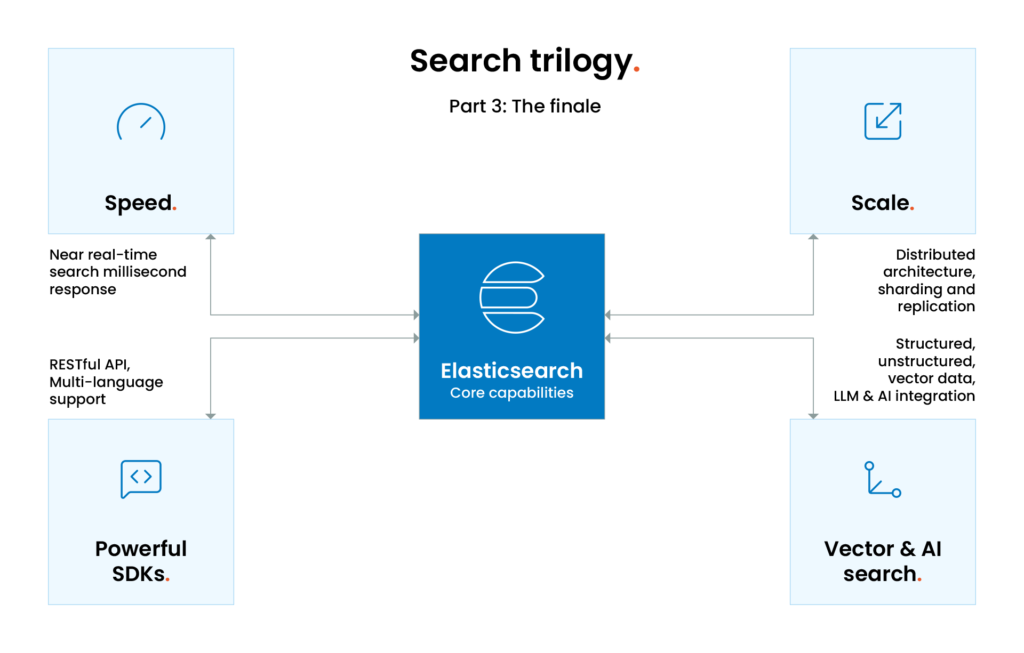
At its core, Elasticsearch is a highly scalable, RESTful search and analytics engine. It isn’t just about querying text; it’s an ecosystem designed to ingest, search, analyze, and visualize data in near real-time.
Key capabilities:
- Versatile data handling: Seamlessly stores and searches structured, unstructured, and vector data—making it highly relevant for modern LLM and AI applications.
- Near real-time search: Data becomes searchable almost instantaneously after ingestion.
- Dynamic mapping & flexible schemas: You don’t have to define strict schemas upfront; documents can contain fields that weren’t explicitly specified in the index.
- Extensive language support: Ships with robust SDKs across major tech stacks, including Java, Python, .NET/C#, JavaScript, Go, Ruby, Rust, and PHP.
Under the hood: Architecture & Apache Lucene
If you read our Apache Solr deep dive, you’ll recognize the engine under the hood: Apache Lucene.
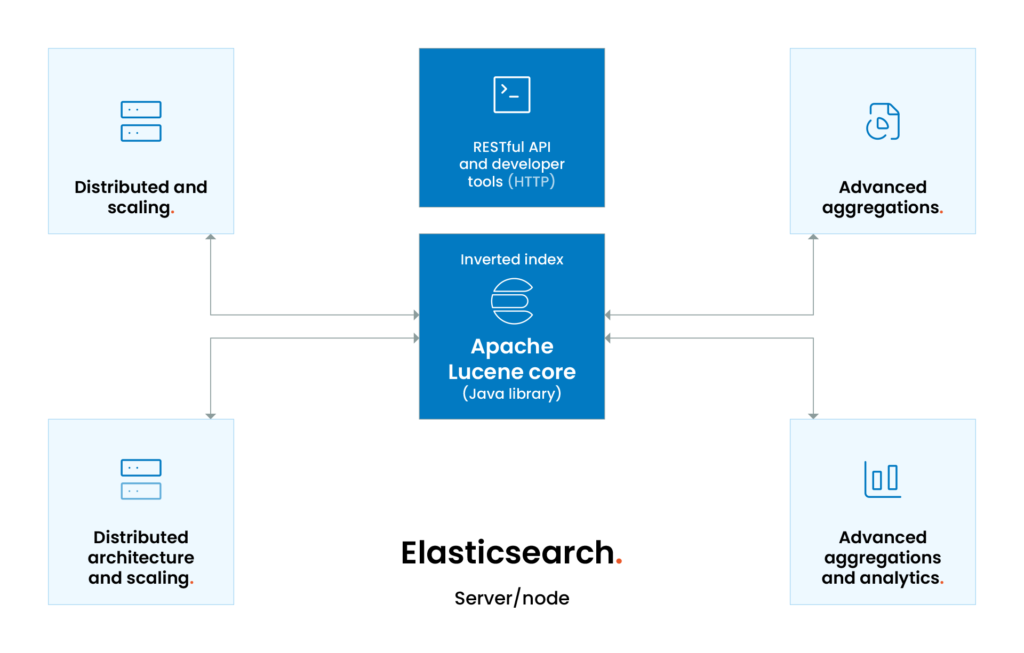
Lucene is a powerful, Java-based open-source information retrieval library. However, Lucene itself is just a library, not a ready-to-use distributed server. Elasticsearch wraps Lucene in a full-fledged search and analytics system, elevating it by adding:
- A distributed architecture: Built from the ground up to scale horizontally.
- RESTful APIs: Making it incredibly developer-friendly and accessible over standard HTTP.
- Advanced aggregations: Allowing complex analytics, math, and data summarization on the fly.
The language of Elasticsearch: Core terminology
To navigate Elasticsearch effectively, you need to speak the language. Here is a quick cheat sheet of the most critical concepts:
- Node: A single running instance of Elasticsearch.
- Cluster: A collection of one or more nodes working together to hold data and provide federated indexing and search capabilities.
- Document: A collection of fields defined in JSON format. This is the basic unit of information that can be indexed.
- Index: A collection of different documents that share similar characteristics (analogous to a database table in the SQL world).
- Shard: Indexes are horizontally subdivided into shards. Each shard is a fully functional, independent “index” that can be hosted on any node, allowing the system to distribute data and scale beyond the hardware limits of a single server.
- Replica: Copies of your shards. Replicas provide high availability in the event of a node failure and improve search performance by handling concurrent read requests.
The full power of the Elastic Stack (ELK)
While Elasticsearch is powerful on its own, it rarely operates in a vacuum. The true enterprise value is unlocked through the Elastic Stack, famously known as ELK.
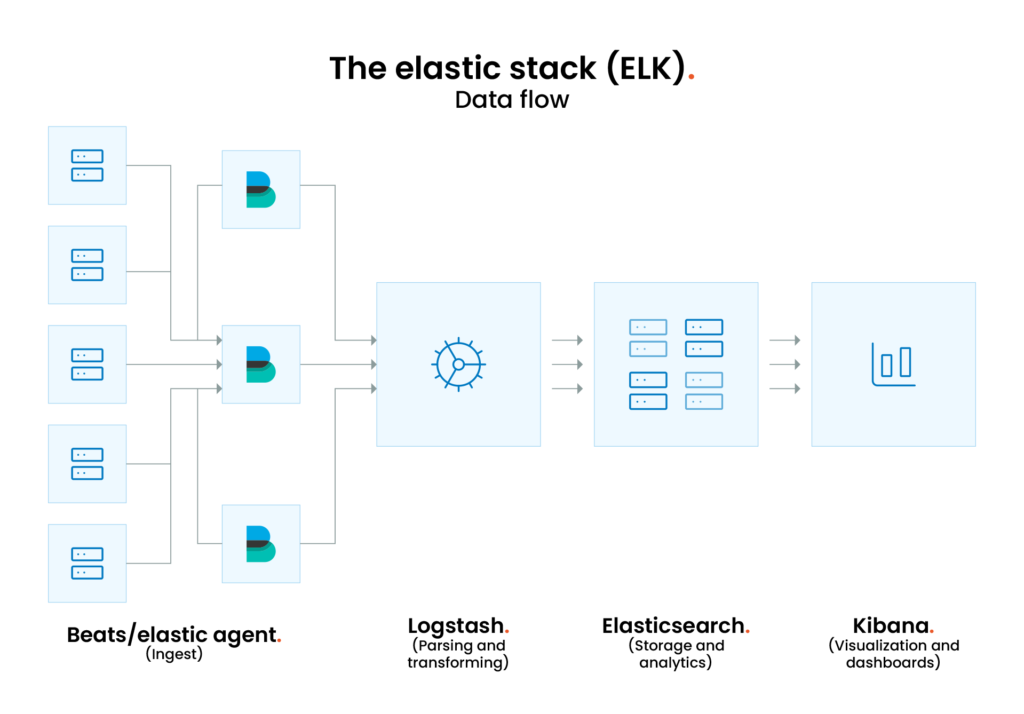
Elasticsearch: The heart of the stack; the core search and analytics engine.
Kibana: The visualization and dashboarding tool. It provides a powerful UI for searching, viewing, and interacting with data stored in Elasticsearch indices.
Logstash: A server-side data processing pipeline. It dynamically ingests data from multiple sources, parses and transforms it, and forwards it to Elasticsearch.
Beats / Elastic Agent: Lightweight, purpose-built data shippers installed on servers to capture and send operational data (like logs or network metrics) directly to Elasticsearch or through Logstash.
How it works: Indexing and searching
The workflow in Elasticsearch revolves around two primary operations: getting data in (Indexing) and getting answers out (Searching).
1. Indexing (ingesting data)
Because mappings aren’t overly strict, getting started is fast. You create an index and simply POST your JSON documents. The system analyzes the data, creates the inverted indices (via Lucene), and makes them available for search.
2. Searching
Elasticsearch relies on GET methods paired with a massive variety of query parameters to deliver precise outcomes. You can query via the URL (e.g., /school*/_search) or utilize rich body variables in a JSON payload. Complex queries can leverage techniques like:
- match_phrase for exact string matching.
- multi_match for searching across multiple fields simultaneously.
- fuzzy for typo-tolerance.
- range and filter for structured data slicing.
Deployment & pricing flexibility
Elasticsearch meets engineering teams where they are, offering versatile deployment options:
- Self-managed: Deploy via Docker/Docker Compose, Kubernetes, or standard Virtual Machines.
- Managed cloud services: Available natively on AWS, Azure, and GCP.
- Elastic cloud serverless: A fully managed tier where Elastic handles infrastructure orchestration, allowing teams to focus purely on sending data and running queries.
Pricing scales with your needs, starting from a Free/Basic tier up to Platinum and Enterprise levels for advanced features and premium support.
The search trilogy showdown: Which platform wins?
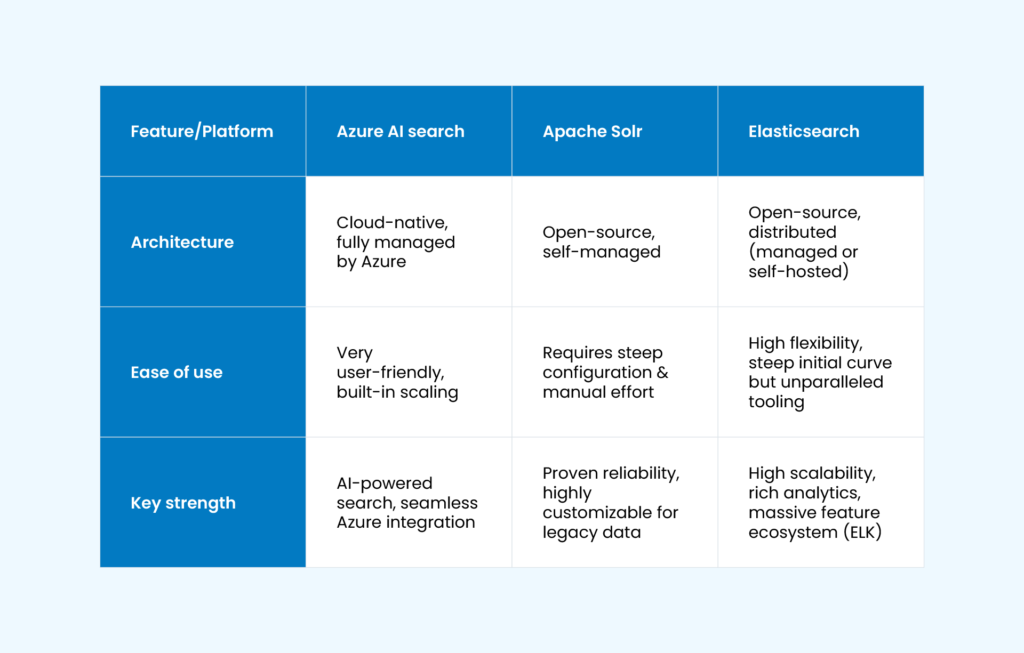
We’ve covered three drastically different search paradigms in this series. Let’s put them side-by-side:
The verdict
While Azure AI Search is a phenomenal choice for teams heavily invested in the Microsoft ecosystem looking for turnkey AI features, and Apache Solr remains a rock-solid, highly customizable veteran, Elasticsearch is the overall winner.
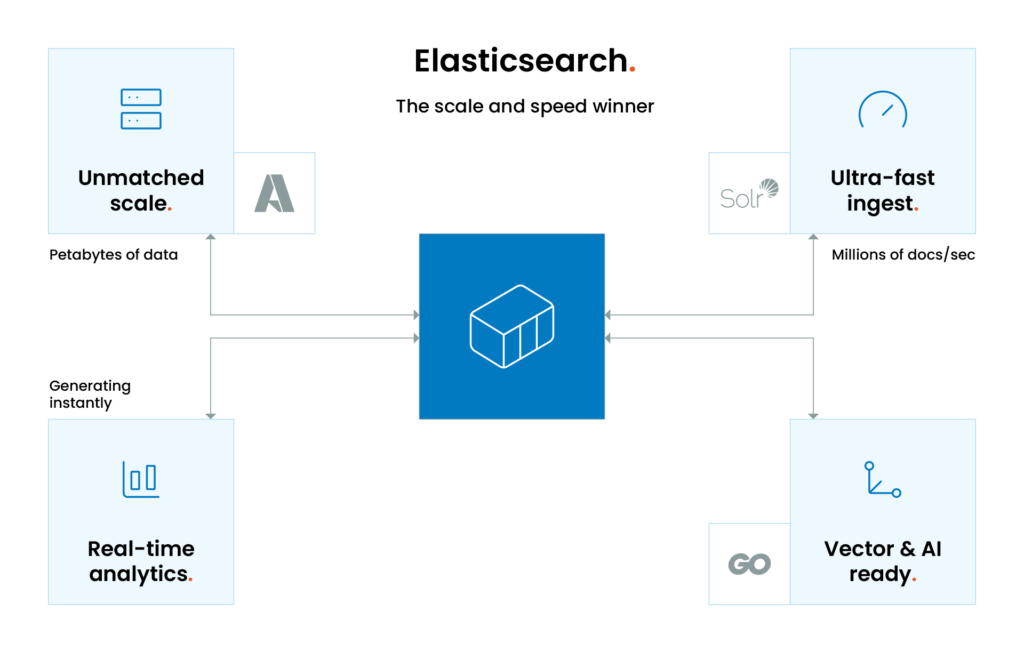
Its unmatched combination of high scalability, active open-source community, advanced vector/AI search capabilities, and the robust visualization power of the ELK stack makes it the most versatile and powerful enterprise search platform on the market today.
Looking to upgrade your enterprise search architecture or implement AI-powered retrieval?
At ProductDock, our engineering teams specialize in architecting highly scalable, data-driven solutions tailored to your business needs.
Get in touch with us today to find out how we can help you unlock the full value of your data.
Tags:Skip tags

Nemanja Marić
Software EngineerNemanja Marić is a software engineer with 6 years of hands-on experience in building robust and scalable applications. He holds a BSc in Software Engineering and specializes primarily in Java and Spring. Along the way, he had also explored C#, React, Cloud Computing, and Flutter. He approaches software development with genuine joy and a passion for creating impactful solutions by building scalable, robust, and high-quality software.
Related posts.

KI
Can AI tell you whether a frozen project is actually safe to turn back on?
Bruno Raljić• 22. Okt. 2026
Find out more
Digital solutions, Integration, KI
Two systems, one number, and no rule that gets it right
Danijel Dragičević• 08. Okt. 2026
Find out more
KI
Can AI recover project knowledge that only ever lived in one person’s head?
Bruno Raljić• 01. Okt. 2026
Find out more