
 DE
DE- AI acceleration
- Industries
- Finance
Nearshore software development for finance—secure, scalable, and compliant solutions for banking, payments, and APIs.
- Retail
Retail software development services—e-commerce, POS, logistics, and AI-driven personalization from nearshore engineering teams.
- Manufacturing
Nearshore manufacturing software development—ERP systems, IoT platforms, and automation tools to optimize industrial operations.
- Finance
- What we do
- Services
- Software modernization services
- Cloud solutions
- AI – Artificial intelligence
- Idea validation & Product development services
- Digital solutions
- Integrations for digital ecosystems
- A11y – Accessibility
- QA – Test development
- Technologies
- Front-end
- Back-end
- DevOps & CI/CD
- Cloud
- Mobile
- Collaboration models
- Collaboration models
Explore collaboration models customized to your specific needs: Complete nearshoring teams, Local heroes from partners with the nearshoring team, or Mixed tech teams with partners.
- Way of work
Through close collaboration with your business, we create customized solutions aligned with your specific requirements, resulting in sustainable outcomes.
- Collaboration models
- Services
- About Us
- Who we are
We are a full-service nearshoring provider for digital software products, uniquely positioned as a high-quality partner with native-speaking local experts, perfectly aligned with your business needs.
- Meet our team
ProductDock’s experienced team proficient in modern technologies and tools, boasts 15 years of successful projects, collaborating with prominent companies.
- Why nearshoring
Elevate your business efficiently with our premium full-service software development services that blend nearshore and local expertise to support you throughout your digital product journey.
- Who we are
- Our work
- Career
- Life at ProductDock
We’re all about fostering teamwork, creativity, and empowerment within our team of over 120 incredibly talented experts in modern technologies.
- Open positions
Do you enjoy working on exciting projects and feel rewarded when those efforts are successful? If so, we’d like you to join our team.
- Hiring guide
How we choose our crew members? We think of you as a member of our crew. We are happy to share our process with you!
- Rookie boot camp internship
Start your IT journey with Rookie boot camp, our paid internship program where students and graduates build skills, gain confidence, and get real-world experience.
- Life at ProductDock
- Newsroom
- News
Stay engaged with our most recent updates and releases, ensuring you are always up-to-date with the latest developments in the dynamic world of ProductDock.
- Events
Expand your expertise through networking with like-minded individuals and engaging in knowledge-sharing sessions at our upcoming events.
- News
- Blog
- Get in touch

10. Sep 2026 •4 minutes read
Elasticsearch deep dive: From distributed search to the full power of the ELK stack
Nemanja Marić
Software Engineer
Following our deep dives into Azure AI Search (Part 1), and Apache Solr (Part 2), we now explore the industry heavyweight: Elasticsearch.
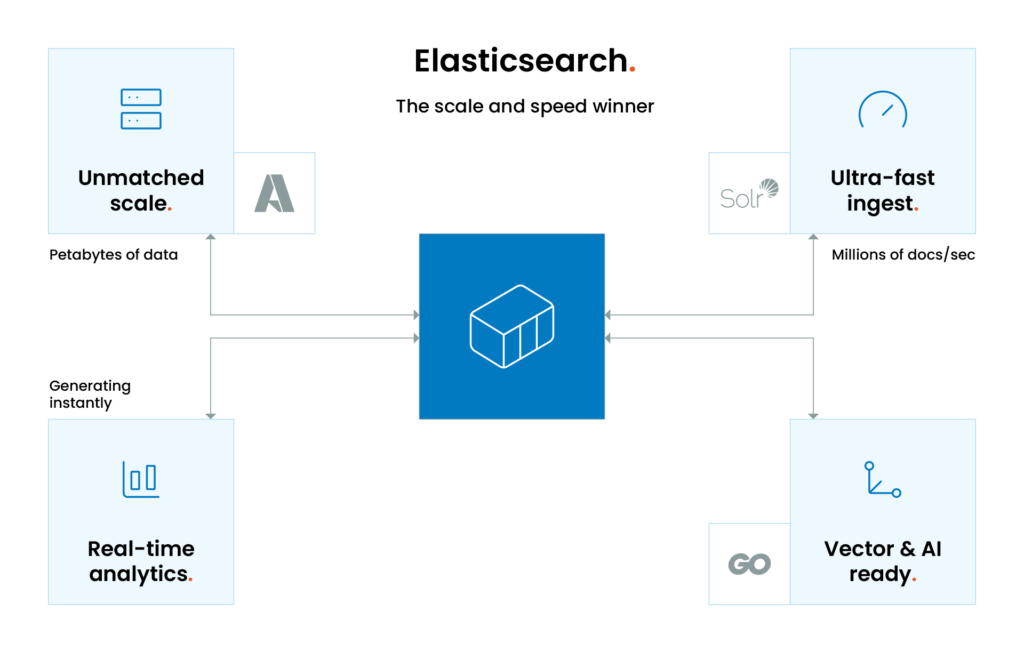
Built for unprecedented speed, massive scale, and modern AI applications, this open-source, distributed engine is the go-to solution for structured, unstructured, and vector data.
Let’s unpack how Elasticsearch works, why the ELK stack is a game-changer, and which platform ultimately claims the throne in our Trilogy Showdown.
What is Elasticsearch?
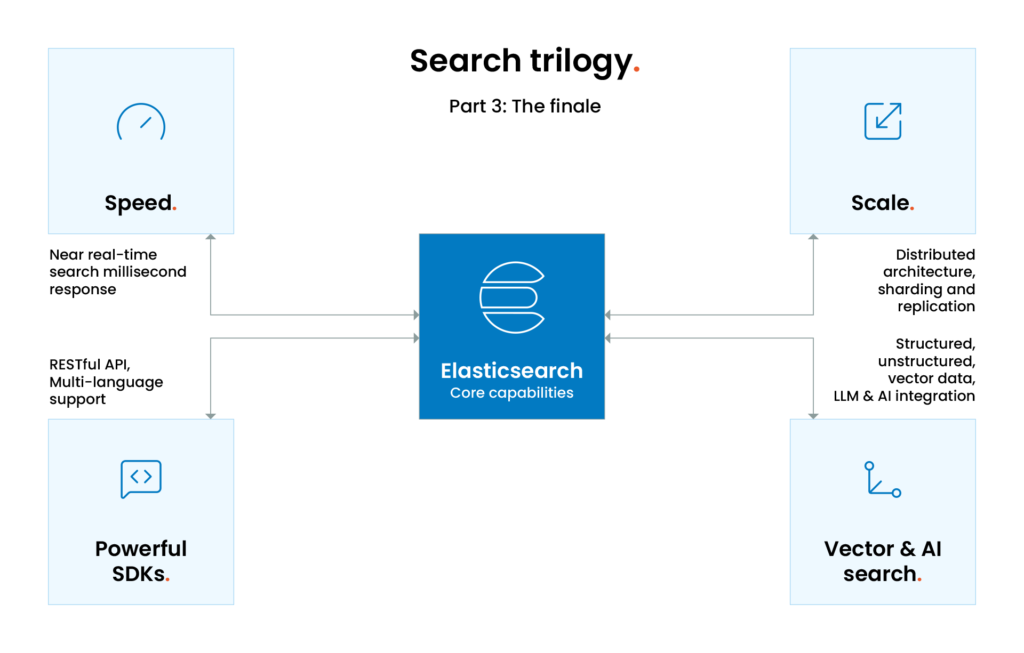
At its core, Elasticsearch is a highly scalable, RESTful search and analytics engine. It isn’t just about querying text; it’s an ecosystem designed to ingest, search, analyze, and visualize data in near real-time.
Key capabilities:
- Versatile data handling: Seamlessly stores and searches structured, unstructured, and vector data—making it highly relevant for modern LLM and AI applications.
- Near real-time search: Data becomes searchable almost instantaneously after ingestion.
- Dynamic mapping & flexible schemas: You don’t have to define strict schemas upfront; documents can contain fields that weren’t explicitly specified in the index.
- Extensive language support: Ships with robust SDKs across major tech stacks, including Java, Python, .NET/C#, JavaScript, Go, Ruby, Rust, and PHP.
Under the hood: Architecture & Apache Lucene
If you read our Apache Solr deep dive, you’ll recognize the engine under the hood: Apache Lucene.
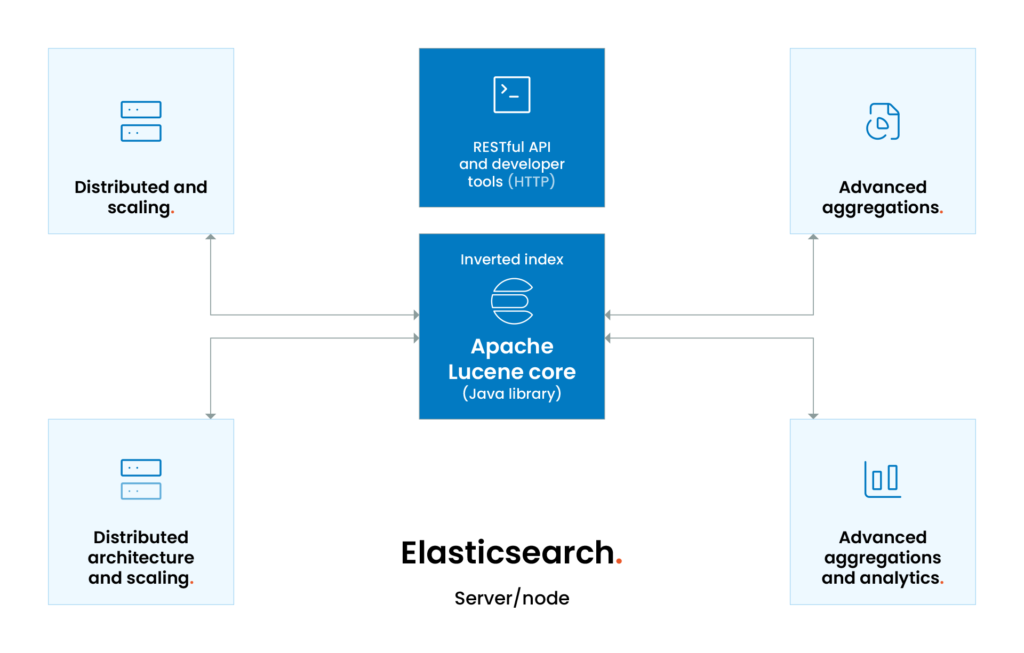
Lucene is a powerful, Java-based open-source information retrieval library. However, Lucene itself is just a library, not a ready-to-use distributed server. Elasticsearch wraps Lucene in a full-fledged search and analytics system, elevating it by adding:
- A distributed architecture: Built from the ground up to scale horizontally.
- RESTful APIs: Making it incredibly developer-friendly and accessible over standard HTTP.
- Advanced aggregations: Allowing complex analytics, math, and data summarization on the fly.
The language of Elasticsearch: Core terminology
To navigate Elasticsearch effectively, you need to speak the language. Here is a quick cheat sheet of the most critical concepts:
- Node: A single running instance of Elasticsearch.
- Cluster: A collection of one or more nodes working together to hold data and provide federated indexing and search capabilities.
- Document: A collection of fields defined in JSON format. This is the basic unit of information that can be indexed.
- Index: A collection of different documents that share similar characteristics (analogous to a database table in the SQL world).
- Shard: Indexes are horizontally subdivided into shards. Each shard is a fully functional, independent “index” that can be hosted on any node, allowing the system to distribute data and scale beyond the hardware limits of a single server.
- Replica: Copies of your shards. Replicas provide high availability in the event of a node failure and improve search performance by handling concurrent read requests.
The full power of the Elastic Stack (ELK)
While Elasticsearch is powerful on its own, it rarely operates in a vacuum. The true enterprise value is unlocked through the Elastic Stack, famously known as ELK.
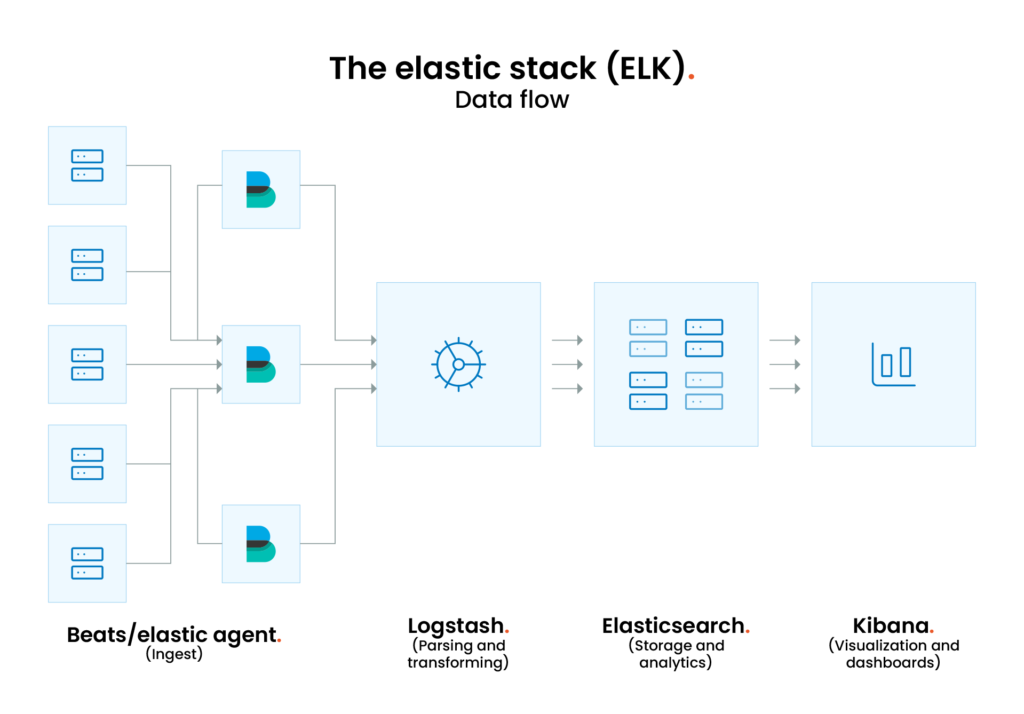
Elasticsearch: The heart of the stack; the core search and analytics engine.
Kibana: The visualization and dashboarding tool. It provides a powerful UI for searching, viewing, and interacting with data stored in Elasticsearch indices.
Logstash: A server-side data processing pipeline. It dynamically ingests data from multiple sources, parses and transforms it, and forwards it to Elasticsearch.
Beats / Elastic Agent: Lightweight, purpose-built data shippers installed on servers to capture and send operational data (like logs or network metrics) directly to Elasticsearch or through Logstash.
How it works: Indexing and searching
The workflow in Elasticsearch revolves around two primary operations: getting data in (Indexing) and getting answers out (Searching).
1. Indexing (ingesting data)
Because mappings aren’t overly strict, getting started is fast. You create an index and simply POST your JSON documents. The system analyzes the data, creates the inverted indices (via Lucene), and makes them available for search.
2. Searching
Elasticsearch relies on GET methods paired with a massive variety of query parameters to deliver precise outcomes. You can query via the URL (e.g., /school*/_search) or utilize rich body variables in a JSON payload. Complex queries can leverage techniques like:
- match_phrase for exact string matching.
- multi_match for searching across multiple fields simultaneously.
- fuzzy for typo-tolerance.
- range and filter for structured data slicing.
Deployment & pricing flexibility
Elasticsearch meets engineering teams where they are, offering versatile deployment options:
- Self-managed: Deploy via Docker/Docker Compose, Kubernetes, or standard Virtual Machines.
- Managed cloud services: Available natively on AWS, Azure, and GCP.
- Elastic cloud serverless: A fully managed tier where Elastic handles infrastructure orchestration, allowing teams to focus purely on sending data and running queries.
Pricing scales with your needs, starting from a Free/Basic tier up to Platinum and Enterprise levels for advanced features and premium support.
The search trilogy showdown: Which platform wins?
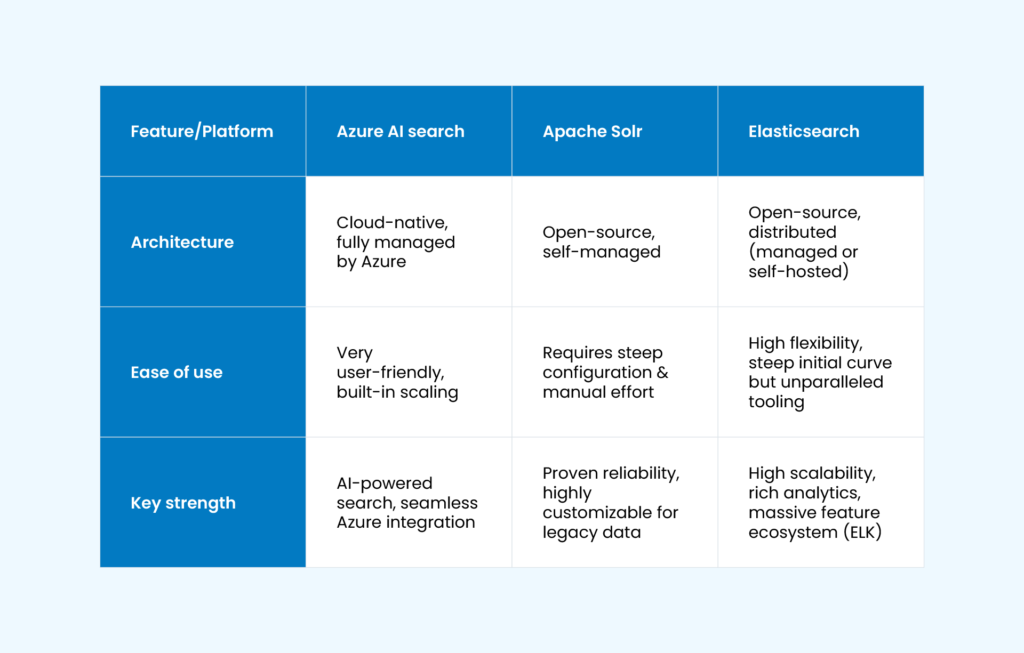
We’ve covered three drastically different search paradigms in this series. Let’s put them side-by-side:
The verdict
While Azure AI Search is a phenomenal choice for teams heavily invested in the Microsoft ecosystem looking for turnkey AI features, and Apache Solr remains a rock-solid, highly customizable veteran, Elasticsearch is the overall winner.
Its unmatched combination of high scalability, active open-source community, advanced vector/AI search capabilities, and the robust visualization power of the ELK stack makes it the most versatile and powerful enterprise search platform on the market today.
Looking to upgrade your enterprise search architecture or implement AI-powered retrieval?
At ProductDock, our engineering teams specialize in architecting highly scalable, data-driven solutions tailored to your business needs.
Need to scale your search infrastructure or leverage your data better? Explore our data engineering and Cloud architecture services, covering everything from initial ELK stack setup to complex, distributed data pipelines.
Get in touch with us today to find out how we can help you unlock the full value of your data.
Tags:Skip tags

Nemanja Marić
Software EngineerNemanja Marić is a software engineer with 6 years of hands-on experience in building robust and scalable applications. He holds a BSc in Software Engineering and specializes primarily in Java and Spring. Along the way, he had also explored C#, React, Cloud Computing, and Flutter. He approaches software development with genuine joy and a passion for creating impactful solutions by building scalable, robust, and high-quality software.
Related posts.

AI
Can AI tell you whether a frozen project is actually safe to turn back on?
Bruno Raljić• 22. Oct 2026
Find out more
AI, Digital solutions, Integration
Two systems, one number, and no rule that gets it right
Danijel Dragičević• 08. Oct 2026
Find out more
AI
Can AI recover project knowledge that only ever lived in one person’s head?
Bruno Raljić• 01. Oct 2026
Find out more