DE
DE- Industries
- Finance
Nearshore software development for finance—secure, scalable, and compliant solutions for banking, payments, and APIs.
- Retail
Retail software development services—e-commerce, POS, logistics, and AI-driven personalization from nearshore engineering teams.
- Manufacturing
Nearshore manufacturing software development—ERP systems, IoT platforms, and automation tools to optimize industrial operations.
- Finance
- What we do
- Services
- Software modernization services
- Cloud solutions
- AI – Artificial intelligence
- Idea validation & Product development services
- Digital solutions
- Integration for digital ecosystems
- A11y – Accessibility
- QA – Test development
- Technologies
- Front-end
- Back-end
- DevOps & CI/CD
- Cloud
- Mobile
- Collaboration models
- Collaboration models
Explore collaboration models customized to your specific needs: Complete nearshoring teams, Local heroes from partners with the nearshoring team, or Mixed tech teams with partners.
- Way of work
Through close collaboration with your business, we create customized solutions aligned with your specific requirements, resulting in sustainable outcomes.
- Collaboration models
- Services
- About Us
- Who we are
We are a full-service nearshoring provider for digital software products, uniquely positioned as a high-quality partner with native-speaking local experts, perfectly aligned with your business needs.
- Meet our team
ProductDock’s experienced team proficient in modern technologies and tools, boasts 15 years of successful projects, collaborating with prominent companies.
- Why nearshoring
Elevate your business efficiently with our premium full-service software development services that blend nearshore and local expertise to support you throughout your digital product journey.
- Who we are
- Our work
- Career
- Life at ProductDock
We’re all about fostering teamwork, creativity, and empowerment within our team of over 120 incredibly talented experts in modern technologies.
- Open positions
Do you enjoy working on exciting projects and feel rewarded when those efforts are successful? If so, we’d like you to join our team.
- Hiring guide
How we choose our crew members? We think of you as a member of our crew. We are happy to share our process with you!
- Rookie boot camp internship
Start your IT journey with Rookie boot camp, our paid internship program where students and graduates build skills, gain confidence, and get real-world experience.
- Life at ProductDock
- Newsroom
- News
Stay engaged with our most recent updates and releases, ensuring you are always up-to-date with the latest developments in the dynamic world of ProductDock.
- Events
Expand your expertise through networking with like-minded individuals and engaging in knowledge-sharing sessions at our upcoming events.
- News
- Blog
- Get in touch

01. Dec 2025 •9 minutes read
Software development delays: Main causes and how to fix them
ProductDock
Software development delays are among the biggest challenges in the product development cycle and are often the main reason costs increase. Delays don’t just add development expenses, they can also frustrate clients, damage customer relationships, and reduce overall team motivation and productivity.
Because of the harm they cause, it’s essential to recognize the most common causes of software development delays and learn how to address them before they turn into larger issues. In this article, we will walk you through the main causes of software development delays and the best ways to fix them.
Consequences of delays
Businesses today are under constant pressure to update and improve their products quickly in order to meet rising customer expectations and stay competitive. This often leads to rushed decisions, hurried team selection, shifting requirements, and ultimately delays. While some companies accept delays as a “normal” part of the software development cycle, doing so can have serious long-term consequences for business success. Here are some of the most common consequences of software development delays:
- Financial loss. Development delays may increase costs due to extra work hours, additional resource allocation, or contractual penalties, for example, if delays prevent compliance with legal or industry regulations. In addition to these immediate expenses, delays could reduce potential revenue if competitors reach the market first, causing missed opportunities. If delays occur often, the financial impact might not only affect the success of a single project but also the company’s broader growth strategy.
- Team motivation and morale. Project delays not only impact your finances but your team as well. When project delays occur, developers often face increased pressure and longer hours, which can lead to stress and burnout. If this repeats, your team members may feel that their work doesn’t make sense or is undervalued, reducing motivation and engagement. Over time, low morale can result in decreased collaboration, higher turnover, and a slower pace of work, creating a cycle where delays lead to even more delays.
- Reputation damage. Frequent and repeated delays in software development can damage a company’s reputation among partners and stakeholders. Missing deadlines may create the impression that the company is unreliable, disorganized, or unable to deliver on its own plans, making it harder to form and retain strategic partnerships. Even if the product is high quality and promising, repeated delays can erode trust and credibility over time.
- Client dissatisfaction. Repeated delays can damage client relationships, particularly when they are counting on an update or new feature to support their own business plans. If delays occur frequently, they can trigger complaints and even lead clients to choose competitors’ solutions.
Common causes of software development delays and how to fix them
Here are the six most common causes of software development delays and practical ways to address them:
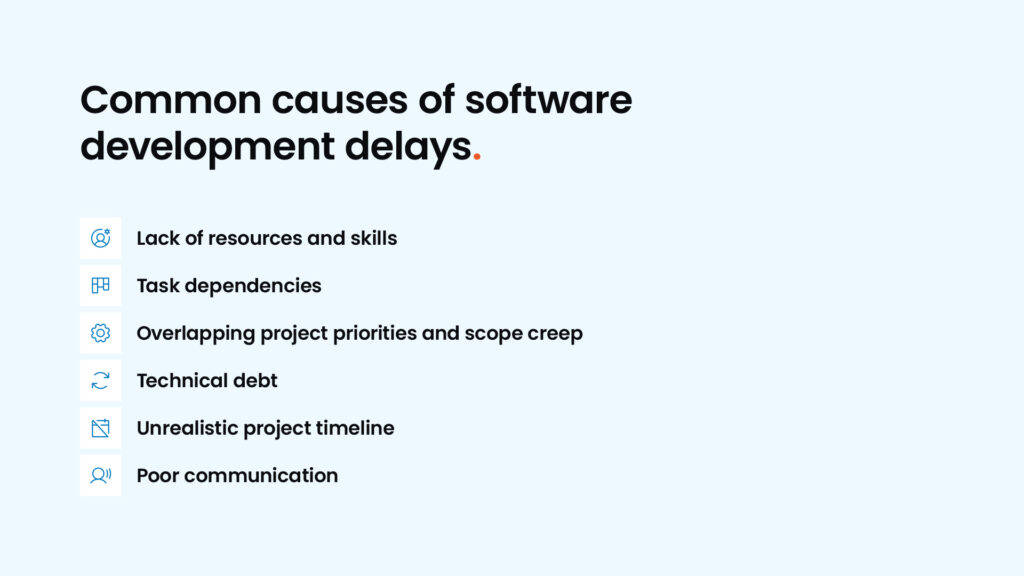
Lack of resources and skills
One of the most common reasons for software development delays is the lack of the right technical expertise. This challenge is particularly noticeable in developed countries where companies face a labor shortage. For example, in Sweden, around 80% of companies report a lack of sufficient IT support.
When the necessary skills are missing, projects suffer from costly mistakes, longer development times, and lower team morale. Imagine building a mobile app without anyone experienced in iOS development, your team will end up spending valuable time learning the technology, experimenting through trial and error, and fixing preventable bugs instead of making steady progress.
How to fix
Before starting the project, conduct a thorough skills and capacity audit. If you discover gaps, bring in the right expertise early on. Flexible arrangements, such as short-term contractors or nearshore partners, can help you scale your team up or down as the project evolves. Just as important, ensure your team includes people who understand the technology stack required for your project’s specific needs.
For example, a multinational fashion retailer operating brick-and-mortar stores across 18 European countries partnered with a nearshore team to support its rapidly growing e-commerce platform. Together, they implemented the MuleSoft Anypoint Platform as the central integration layer for all company interfaces. As business needs evolved, the demand for new integrations increased, requiring the expansion of MuleSoft capabilities. Thanks to the flexibility of the nearshoring team, the company was able to seamlessly adjust the number of experts as priorities shifted, ensuring the project kept pace with growth and that everything was delivered on time.
Task dependencies
In software development, it is very common that one task cannot start or finish until another one is completed. For example, certain features rely on others being built first, or some back-end systems must be ready before front-end work can proceed. These dependencies can lead to cascading delays across multiple teams, wasted time, and frustration among developers. They often result in missed deadlines and increased pressure to rush subsequent tasks, which can compromise quality as well. Regular check-ins, such as daily stand-ups, help teams stay aligned, similar to how design system principles improve collaboration consistency.
How to fix
To address task dependencies, effective project management and planning are crucial. At the beginning of the project, identify and map dependencies, and structure tasks so that parts of the work can proceed independently, minimizing bottlenecks. Regular check-ins, such as daily stand-ups or weekly syncs, help teams monitor critical dependencies and address potential issues before they cascade into delays. Consider using tools like Jira, Trello, or Asana to allow everyone involved to track progress and stay aligned. Following an Agile framework, such as Scrum or Kanban, further supports managing dependencies by breaking work into iterative sprints, promoting collaboration, and enabling teams to adjust priorities quickly. By combining careful dependency planning, parallel work streams, and agile practices, teams can maintain a steady workflow and keep projects on schedule.
“Our nearshore IT team managed the project efficiently, ensuring an effective workflow. They communicated via Jira, Slack, Google Workspace, and Zoom. Their linguistic flexibility and genuine interest were noteworthy.”
Peter Laufer, Director of Engineering, Adevinta
Overlapping project priorities and scope creep
In software development, it is not uncommon for a single team to be responsible for maintaining an existing platform, developing new features, addressing everyday issues, and working on a new project simultaneously. This situation often pulls the team in multiple directions at once, forcing them to juggle several projects and tasks, increasing the risk of software development delays. In addition, in fast-paced environments, stakeholders may continually request new features or change priorities mid-project, leading to scope creep, where the goals or requirements of a project gradually expand beyond the original plan, often without adjusting timelines or resources.
When this happens, teams can become overextended, constantly switching contexts between tasks. This reduces productivity, increases the risks of errors, and can lower team morale, ultimately leading to software development delays.
How to fix
To prevent scope creep and manage overlapping priorities, it is crucial to set clear project objectives and communicate them to all stakeholders from the start. Any new feature requests or changes should go through a change management process that evaluates their impact on timelines, resources, and overall project goals. However, if overlapping priorities and workloads are unavoidable, instead of overloading an already busy in-house team, consider nearshoring. Nearshore teams can act as an extended arm of your internal development team and help prevent costly delays. By enforcing clear scope boundaries and structured prioritization, teams can stay focused, deliver on time, and reduce stress caused by shifting demands.
For example, BMS Consulting GmbH from Düsseldorf, Germany, integrated nearshore developers into their Scrum team to develop a scalable advisory application for a German banking group. The nearshore team embraced their role fully, working seamlessly with in-house teams. Their high level of organization and development expertise ensured that the project progressed efficiently despite evolving priorities.
Technical debt
Technical debt causes delays as well and is often one of the leading drivers of software development costs. But what exactly does that mean? Quick fixes, poorly documented code, or skipped testing in software development can have serious long-term consequences. Teams facing tight deadlines or lacking expertise often take shortcuts to deliver faster. Over time, these shortcuts accumulate, making the system harder to maintain, scale, and update. This is known as technical debt.
Unchecked technical debt slows down future development, increases the risk of errors, and raises costs. Teams may spend more time troubleshooting and fixing old issues than building new features, which can result in delays. Over time, excessive technical debt can even threaten the stability of the entire system.
How to fix
Treat technical debt like financial debt, acknowledge it, track it, and allocate time to “repay” it regularly. This means scheduling refactoring sessions, maintaining proper documentation, and conducting code reviews. If your in-house team is overburdened, partnering with a nearshore team can help. External teams can focus on improving code quality and addressing accumulated debt without slowing down new feature development. By proactively managing technical debt, you can maintain a stable, scalable codebase and reduce long-term delays.
Unrealistic project timeline
When companies try to accelerate time-to-market or cut development costs, they sometimes set deadlines without properly considering the complexity of the work or potential risks. Also, in some cases, project managers may misestimate project objectives and resources, which can result in unrealistic timelines. When project timelines are unrealistic, teams are forced to rush development, often compromising quality and increasing the likelihood of bugs, reworks, and missed deadlines.
How to fix
To fix unrealistic project timelines, it is crucial to involve both product and project managers in estimating the work based on past projects and the complexity of current requirements. While the product manager focuses on what and why to build, the project manager knows how and when to deliver it. This alignment is essential to set realistic expectations and ensure project success.
Additionally, break down the project tasks into milestones and reassess each task effort realistically, considering complexity, dependencies, and team capacity. Prioritize critical tasks and define a minimum viable deliverable to focus on what truly matters, while adding buffers for unexpected issues. Then, adjust the schedule based on these realistic estimates, reallocate or add resources where possible, and communicate the revised timeline clearly to stakeholders to set proper expectations.
Continually monitor progress, address risks proactively, and remain flexible to update the timeline as challenges arise, ensuring the project stays achievable without overburdening the team members. If the timeline cannot be changed, consider outsourcing developers to avoid additional hiring and training costs.
“Our nearshoring team understands the difference between product and project developers, helping us a lot right from the start.”
Andreas Engels, Managing Director for IT & Product, Kerberos
Poor communication
One of the most common causes of delays is ineffective or insufficient communication within the development team or with stakeholders. This can lead to misunderstandings about requirements, priorities, and responsibilities. When expectations are unclear, tasks may be duplicated, important details overlooked, and deadlines missed. Communication issues not only slow progress but also create errors, rework, and frustration, all of which contribute to project delays.
How to fix
Establish clear and consistent communication channels between all team members. Schedule regular check-ins and status updates to ensure everyone is aligned on priorities and progress. Review updates promptly and provide timely feedback to prevent misunderstandings and delays. Using collaboration and project management tools can help improve coordination and keep the project on track.
Many companies worry about communication challenges when working with outsourced teams, due to differences in location and language. However, there are nearshore providers with local professionals fluent in multiple languages, which helps minimize misunderstandings.
Many companies worry about communication challenges when working with outsourced teams, due to differences in location and language. However, there are nearshore providers with local professionals fluent in multiple languages, which helps minimize misunderstandings.
For example, when VisualVest, a platform-as-a-service provider for the cooperative banking sector in Germany, began its partnership with the nearshore software development team, they had a German-speaking Product Owner, Designer, and Scrum Master. To enhance collaboration, their nearshore team included a German-speaking Agile Coach to support the ramp-up phase and facilitate the team’s seamless integration into VisualVest. This approach contributed to improved productivity, collaboration, and successful project development.
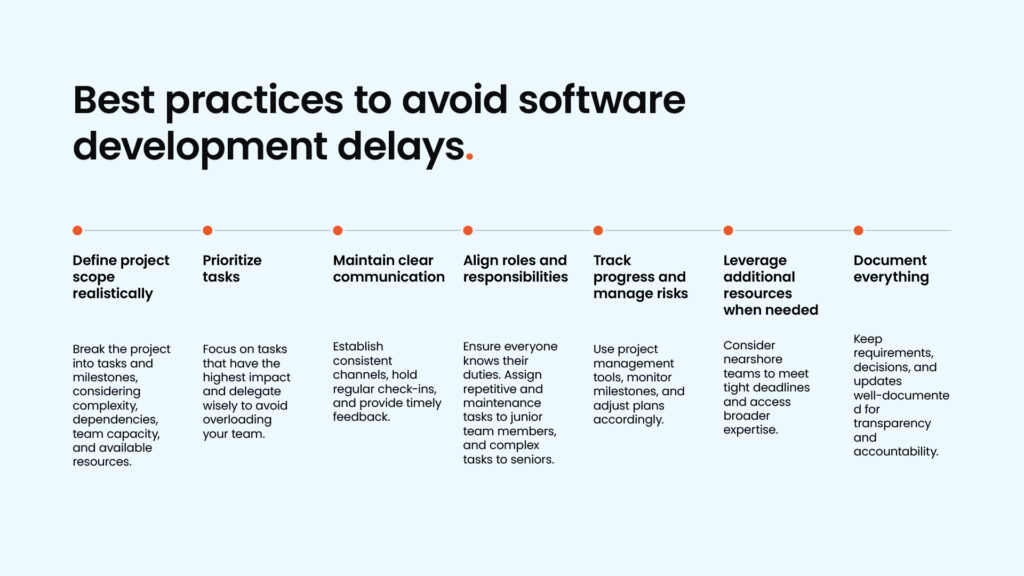
Best practices to avoid software development delays
Keeping a project on track requires careful planning, clear communication, proactive management, and collaboration with an experienced development team. Here are some best practices to minimize software development delays:
- Define project scope realistically: Break the project into tasks and milestones, considering complexity, dependencies, team capacity, and available resources.
- Prioritize tasks: Focus on tasks that have the highest impact and delegate wisely to avoid overloading your team.
- Maintain clear communication: Establish consistent channels, hold regular check-ins, and provide timely feedback.
- Align roles and responsibilities: Ensure everyone knows their duties. Assign repetitive and maintenance tasks to junior team members, and complex tasks to seniors.
- Track progress and manage risks: Use project management tools, monitor milestones, and adjust plans accordingly.
- Leverage additional resources when needed: Consider nearshore teams to meet tight deadlines and access broader expertise.
- Document everything: Keep requirements, decisions, and updates well-documented for transparency and accountability.
Conclusion
Software development is a complex process, and delays are sometimes inevitable. Frequent and repeated delays, however, can have serious consequences, not only to your budget and team morale, but also for the overall success of your project. By combining proactive planning, realistic estimation of time and resources, and strong team coordination, you can reduce software development delays, meet customer expectations, and maintain trust.
Thorough planning and an experienced team on your side can minimize these risks. It’s important to remember that success is not just about bringing a product to market, it’s about bringing a product of high quality. Poor-quality of your software can damage the trust of consumers faster than any delay ever could.

Related posts.

General
How to do capacity planning for software development teams
ProductDock• 12. Feb 2026
Find out more