
 DE
DE- AI acceleration
- Industries
- Finance
Nearshore software development for finance—secure, scalable, and compliant solutions for banking, payments, and APIs.
- Retail
Retail software development services—e-commerce, POS, logistics, and AI-driven personalization from nearshore engineering teams.
- Manufacturing
Nearshore manufacturing software development—ERP systems, IoT platforms, and automation tools to optimize industrial operations.
- Finance
- What we do
- Services
- Software modernization services
- Cloud solutions
- AI – Artificial intelligence
- Idea validation & Product development services
- Digital solutions
- Integrations for digital ecosystems
- A11y – Accessibility
- QA – Test development
- Technologies
- Front-end
- Back-end
- DevOps & CI/CD
- Cloud
- Mobile
- Collaboration models
- Collaboration models
Explore collaboration models customized to your specific needs: Complete nearshoring teams, Local heroes from partners with the nearshoring team, or Mixed tech teams with partners.
- Way of work
Through close collaboration with your business, we create customized solutions aligned with your specific requirements, resulting in sustainable outcomes.
- Collaboration models
- Services
- About Us
- Who we are
We are a full-service nearshoring provider for digital software products, uniquely positioned as a high-quality partner with native-speaking local experts, perfectly aligned with your business needs.
- Meet our team
ProductDock’s experienced team proficient in modern technologies and tools, boasts 15 years of successful projects, collaborating with prominent companies.
- Why nearshoring
Elevate your business efficiently with our premium full-service software development services that blend nearshore and local expertise to support you throughout your digital product journey.
- Who we are
- Our work
- Career
- Life at ProductDock
We’re all about fostering teamwork, creativity, and empowerment within our team of over 120 incredibly talented experts in modern technologies.
- Open positions
Do you enjoy working on exciting projects and feel rewarded when those efforts are successful? If so, we’d like you to join our team.
- Hiring guide
How we choose our crew members? We think of you as a member of our crew. We are happy to share our process with you!
- Rookie boot camp internship
Start your IT journey with Rookie boot camp, our paid internship program where students and graduates build skills, gain confidence, and get real-world experience.
- Life at ProductDock
- Newsroom
- News
Stay engaged with our most recent updates and releases, ensuring you are always up-to-date with the latest developments in the dynamic world of ProductDock.
- Events
Expand your expertise through networking with like-minded individuals and engaging in knowledge-sharing sessions at our upcoming events.
- News
- Blog
- Get in touch

17. Sep 2026 •5 minutes read
Can AI help you revive a project nobody has touched in years?
Bruno Raljić
Unit Lead & Integrations Service Lead at ProductDock
This post is the first in a series about reviving a project that had sat untouched for years. Each post will explore a different aspect of the process, some technical, others focused on how we interpreted and acted on our findings. This article starts at the very beginning, before anyone had looked at a single line of code. Follow the series for the rest of the story.
Every engineering org has one of those projects that hasn’t been touched in years, and that everyone is a little afraid to go near. The problem isn’t bad code; it’s that nobody currently on the payroll fully understands what’s inside it, and finding out the hard way tends to happen at the worst possible time.
For this post, we picked a project that fits that story well: not business-critical, but complex enough to make the point. Originally built as an internal side project to test new technologies, the fantasy football simulator ended up being a genuinely used tool, with colleagues repeatedly returning to see how the simulated matches played out.
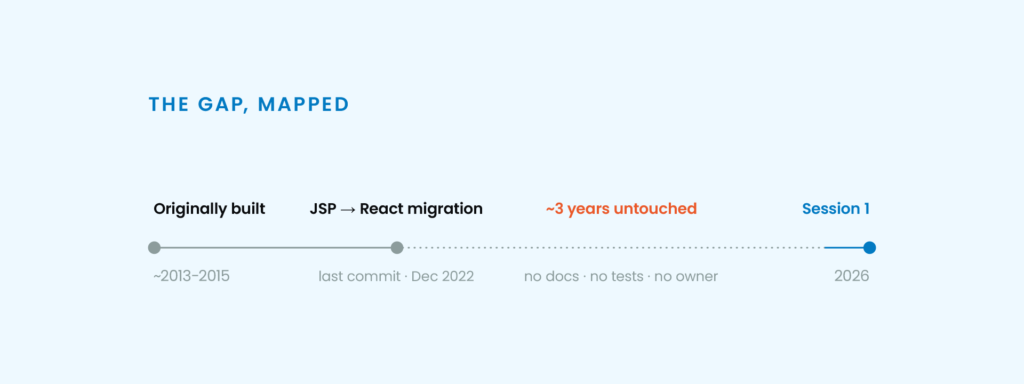
It was abandoned, picked up again in 2022 for a modernization pass, then abandoned a second time. As a fun, internal side project, not something built the way we’d normally build for a client, it had no docs and no tests worth trusting, a black box with a git history that only went back so far: the repo had been moved at some point, and nobody bothered preserving what came before.
What we did
Before opening a single file, the project’s original owner was asked to write down everything they could remember about it, cold, with no peeking at code, down to the smallest detail. What we received went into a real file, one that would actually get used later, not a throwaway exercise. Neither side had a head start: the owner never looked at the code while writing it, and the AI never looked at that file until it was time to compare the two.
Then, we let an AI-assisted team do a full pass on all repos, one session, no code touched:
- Git history
- Stack versions
- Dependency health
- Test coverage
- A scan for committed secrets
- A sweep for dead code and half-finished features
The goal wasn’t just to be fast. It was to see how far a human memory, even an honest, well-intentioned one, genuinely drifts from what’s true after a few years away. And then to build a real, current picture fast enough that “we don’t know what’s in there” stops being an excuse not to touch it.
One technical moment
Buried in the backend was a Java class called Todo.java, whose entire body was comments, fifteen TODO items that never became tickets, plus a leftover MongoDB query and a Windows build path from someone’s old dev machine. One of those comments carried a literal timestamp: ISODate("2014-02-13...").
The project’s creator recalls it being written sometime between 2013 and 2015, though the exact timeframe remains uncertain. A single fossilized comment, never meant to prove anything to anyone, pinned that down to a specific week. That’s the kind of detail you can’t get from a changelog, because there wasn’t one. It survived only by accident, sitting inside a class that probably shouldn’t have existed at all, a running backlog kept as comments in a Java file instead of real tickets, for whatever reason, the developer at the time found that convenient. We don’t know why. We just know nobody had looked at that class in over a decade.
Where AI helped
The reconstruction itself held up well against memory almost everywhere: the match-simulation engine, the betting subsystem, the weather feature that was wired in but never actually affected outcomes, even a “secret” admin endpoint for generating a new season, all confirmed, independently, from the code.
Where it mattered was a smaller, quieter mismatch. The original owner’s memory said the 2022 migration to React was “done.” The reconstruction found it was only partially done: the core engine was ported cleanly, but several pages (Wall of Fame, the betting UI) were still living only as JSP and never finished. Both things were technically true: the instruction at the time was “make it functionally work,” and it did, for the parts that were touched. Nobody had ever written down what “done” was supposed to mean, so two accurate memories of the same project quietly disagreed with each other. Catching that gap and deciding what to do about it needed a human in the loop. An AI reconstruction can tell you what’s there; it can’t tell you which version of “done” the person asking really meant.
That first session pass also ended with a blunt verdict: would we deploy this today? No, for eight concrete reasons:
- Committed OAuth2 secrets and a JWT signing key, sitting in the repo
- Admin endpoints that delete data are reachable with a plain, unauthenticated GET request
- A JWT library with a known algorithm-confusion vulnerability
- A logging library still pinned to a 2006 release, already outdated the day the project was built
- Security configuration built on an API that’s deprecated now, blocking any further upgrade
- A push-notification integration pointing at a service that’s been shut down for years
- A season-generation job that was never finished: it would run once, then stop forever
- Near-zero test coverage on the backend, and none at all on the frontend
All discoverable in one sitting. None of them was a surprise once someone actually looked.
Why this matters if you’re hiring a nearshoring team
This is precisely the kind of challenge a nearshoring team is built for: stepping into a codebase nobody on your side has the time to relearn, and getting it back under control.
What AI changes here isn’t just the pace; it’s what becomes worth taking on in the first place. A frozen, undocumented project like this used to be a hard sell: too much unknown risk for too little certainty going in. A single session that turns “we don’t know what’s in there” into an eight-item list changes that math. Getting oriented to an unfamiliar codebase typically takes up the first few weeks of a new hire’s onboarding (industry average, not a pessimistic number). Here, it took one sitting.
Speed alone isn’t the real selling point; after all, anyone with an AI subscription has access to that now. It’s judgment applied at that speed: knowing which of the eight things above needs fixing first, which can wait, and which shouldn’t be touched without a real conversation first.
None of that made the project any less abandoned. It just changed what “abandoned” meant: no longer a mystery, but a list. That’s a small difference on paper, and the actual difference between a project nobody will touch and a project someone can actually start on. This is just the beginning of that list.
What’s next
The posts that follow cover what real documentation and understanding looked like once we actually opened the code, what a proper security and technical-debt review turned up, what it actually felt like to go from zero test coverage to feeling confident enough to ship a real new feature (compare that to handing an intern a feature request on a codebase nobody can even say is covered), and an honest audit of our own work, including the calls we made about what not to fix. Somewhere in that mix is also a real dead end for AI: not a case where it needed a human to decide, but one where it simply had no answer, no matter how the question was asked.
Stay tuned for the rest of the series to see how we nurture the human-in-the-loop principle at ProductDock and why it has brought results.
Want to see how else AI can transform your engineering processes?
Reviving undocumented legacy code is just one way artificial intelligence is changing how we build products. Explore our AI-accelerated software development services to learn how we integrate advanced AI tools across the entire software development lifecycle to deliver high-quality systems faster.
Tags:Skip tags

Bruno Raljić
Unit Lead & Integrations Service Lead at ProductDockBruno has been in software since 2011, starting as a developer and growing into a role that sits between people, clients, and delivery. At ProductDock, he builds and leads teams, works directly with clients, and focuses on the human side of software projects. He believes that in the age of AI, the people on a project matter more than ever, not less.
Related posts.

AI, Digital solutions, Integration
Two systems, one number, and no rule that gets it right
Danijel Dragičević• 08. Oct 2026
Find out more
AI
Can AI recover project knowledge that only ever lived in one person’s head?
Bruno Raljić• 01. Oct 2026
Find out more
AI, Industry trends
Mastering token economics: The cost of scaling LLM applications
Nemanja Vasić• 24. Sep 2026
Find out more