
 DE
DE- AI acceleration
- Industries
- Finance
Nearshore software development for finance—secure, scalable, and compliant solutions for banking, payments, and APIs.
- Retail
Retail software development services—e-commerce, POS, logistics, and AI-driven personalization from nearshore engineering teams.
- Manufacturing
Nearshore manufacturing software development—ERP systems, IoT platforms, and automation tools to optimize industrial operations.
- Finance
- What we do
- Services
- Software modernization services
- Cloud solutions
- AI – Artificial intelligence
- Idea validation & Product development services
- Digital solutions
- Integrations for digital ecosystems
- A11y – Accessibility
- QA – Test development
- Technologies
- Front-end
- Back-end
- DevOps & CI/CD
- Cloud
- Mobile
- Collaboration models
- Collaboration models
Explore collaboration models customized to your specific needs: Complete nearshoring teams, Local heroes from partners with the nearshoring team, or Mixed tech teams with partners.
- Way of work
Through close collaboration with your business, we create customized solutions aligned with your specific requirements, resulting in sustainable outcomes.
- Collaboration models
- Services
- About Us
- Who we are
We are a full-service nearshoring provider for digital software products, uniquely positioned as a high-quality partner with native-speaking local experts, perfectly aligned with your business needs.
- Meet our team
ProductDock’s experienced team proficient in modern technologies and tools, boasts 15 years of successful projects, collaborating with prominent companies.
- Why nearshoring
Elevate your business efficiently with our premium full-service software development services that blend nearshore and local expertise to support you throughout your digital product journey.
- Who we are
- Our work
- Career
- Life at ProductDock
We’re all about fostering teamwork, creativity, and empowerment within our team of over 120 incredibly talented experts in modern technologies.
- Open positions
Do you enjoy working on exciting projects and feel rewarded when those efforts are successful? If so, we’d like you to join our team.
- Hiring guide
How we choose our crew members? We think of you as a member of our crew. We are happy to share our process with you!
- Rookie boot camp internship
Start your IT journey with Rookie boot camp, our paid internship program where students and graduates build skills, gain confidence, and get real-world experience.
- Life at ProductDock
- Newsroom
- News
Stay engaged with our most recent updates and releases, ensuring you are always up-to-date with the latest developments in the dynamic world of ProductDock.
- Events
Expand your expertise through networking with like-minded individuals and engaging in knowledge-sharing sessions at our upcoming events.
- News
- Blog
- Get in touch

02. Jul 2026 •3 minutes read
Apache Solr deep dive: From full-text search to distributed search architecture
Nemanja Marić
Software Engineer
In the first part of our Search Trilogy, we explored Azure AI Search and how Microsoft combines traditional search, AI enrichment, and vector-based retrieval into a managed cloud solution.
In this second part, we shift the focus to Apache Solr — one of the most widely adopted enterprise search platforms built on Apache Lucene. While Azure AI Search provides a managed cloud-native experience, Solr offers deep flexibility, advanced search capabilities, and full control over distributed search infrastructure.
Apache Solr powers search experiences for organizations such as Netflix, Disney, Bloomberg, eBay, SAP Hybris, and Instagram, proving itself a mature, highly scalable search engine for enterprise environments.
Why Apache Solr?
Traditional SQL databases are not optimized for modern search workloads.
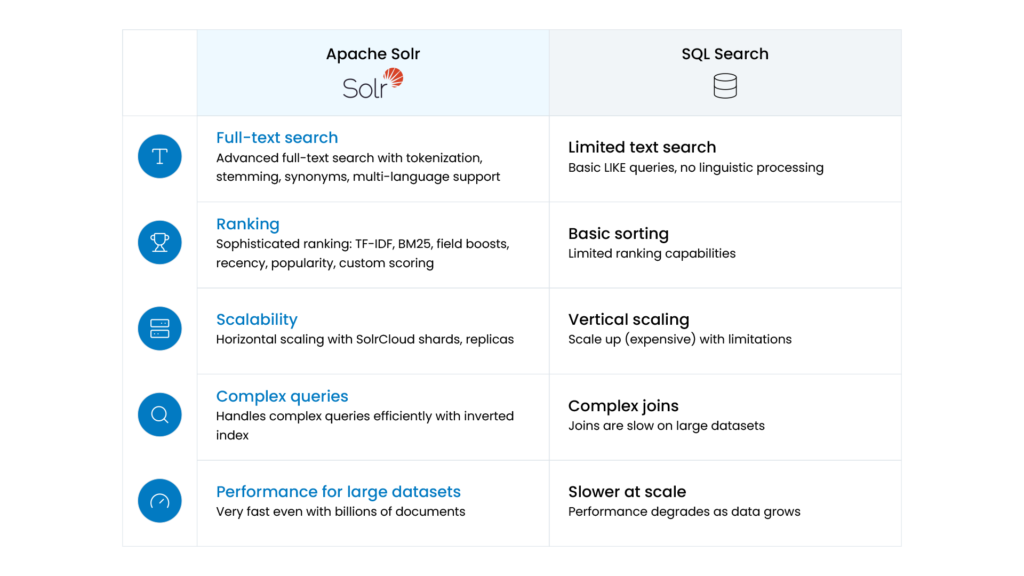
Although SQL queries can support simple filtering and text matching, enterprise applications often require:
- Full-text search
- Multi-language support
- Synonyms and stemming
- Relevance ranking
- Typo tolerance
- Distributed search
- Extremely fast retrieval across large datasets
This is where Apache Solr becomes valuable.
Unlike relational databases, Solr is designed specifically for document retrieval and large-scale search operations.
Key advantages include:
- Advanced full-text search
- Relevance scoring with BM25 and TF-IDF
- Faceted search
- High availability
- Horizontal scalability with SolrCloud
- Efficient inverted indexes
- Fast search performance even with billions of documents
Solr is especially suitable for:
- E-commerce platforms
- News and media portals
- Documentation systems
- Knowledge bases
- Product catalogs
- Large enterprise search systems
Apache Solr architecture
Apache Solr is built on top of Apache Lucene.
Lucene provides the low-level indexing and retrieval engine, while Solr adds enterprise-grade features such as:
- HTTP APIs
- Distributed search
- Clustering
- Schema management
- Analytics
- Monitoring
- High availability
- Faceting and filtering
- AI-related search features
At a high level, the architecture consists of:
- Solr nodes
- Collections
- Shards
- Replicas
- ZooKeeper
- Lucene indexes
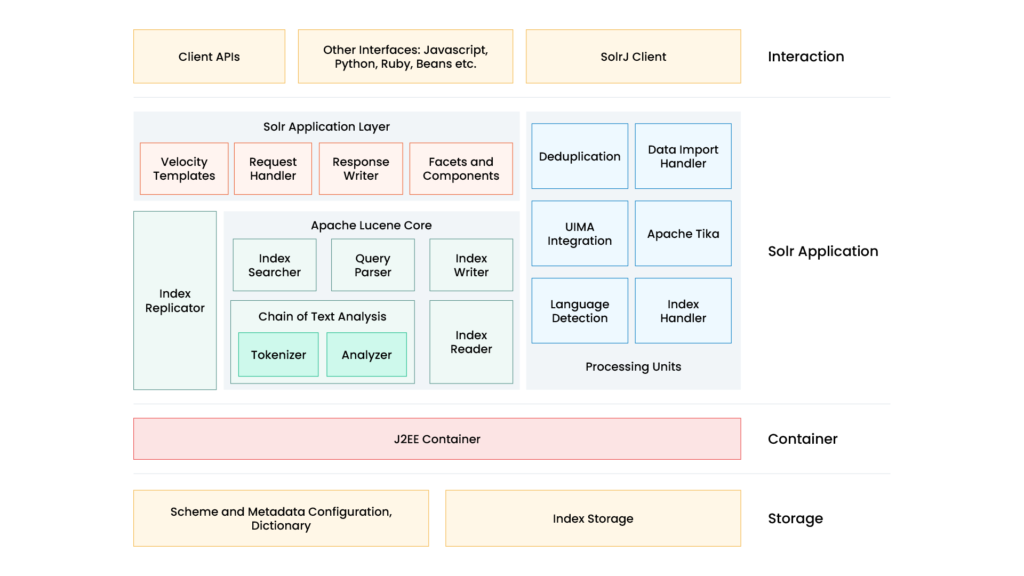
Core components
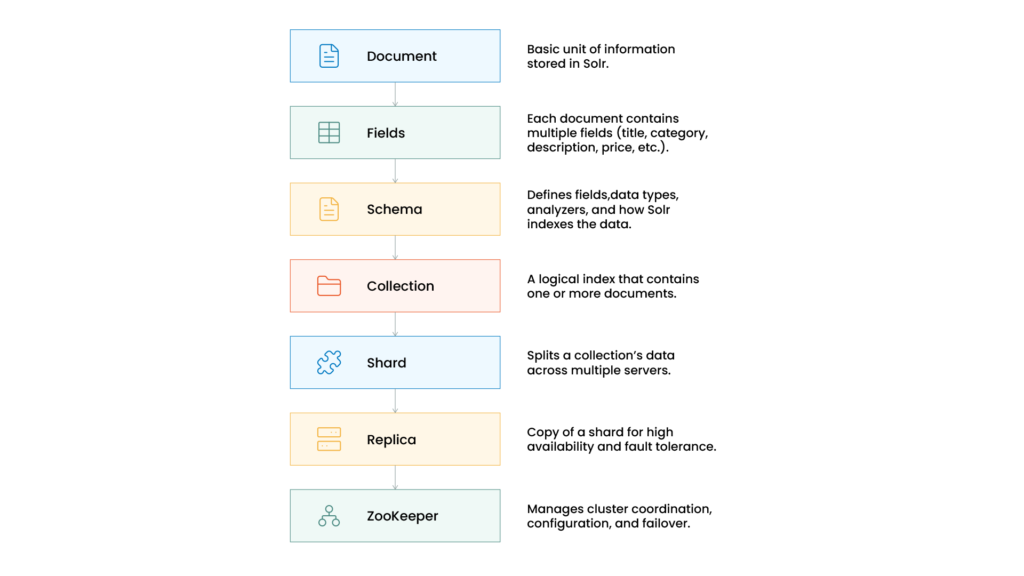
How Apache Solr works
Indexing flow
The indexing process begins when a client sends documents to Solr using the /update endpoint.
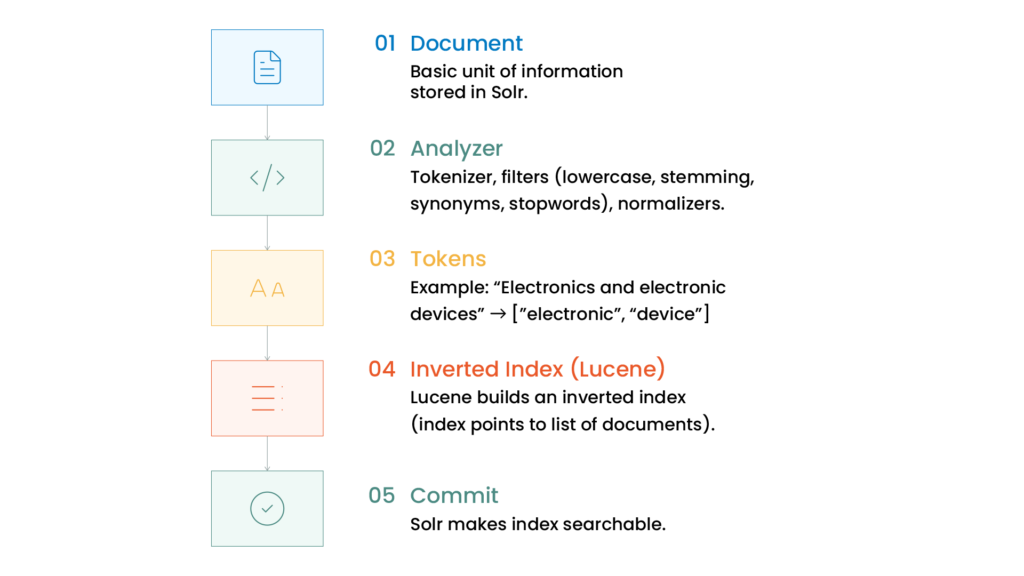
Example flow:
- Client sends document
- Solr transforms it into a SolrInputDocument
- Text analyzers process the content
- Lucene creates inverted indexes
- Solr commits changes and makes data searchable
During analysis, Solr applies:
- Tokenization
- Lowercasing
- Stopword removal
- Synonym handling
- Stemming
Example:
"Electronics and electronic devices"
→ ["electronic", "device"]
This processing significantly improves search relevancy.
Searching flow
Search requests are typically sent through HTTP APIs.
Example query:
/solr/products/select?q=electronics&fq=category:phones&sort=price ascThe process:
- Request Handler processes the query
- Solr receives a request
- Query Parser converts input into Lucene query objects
- Filters are applied separately for caching efficiency
- Lucene performs a search against indexes
- Results are ranked and returned
Solr supports multiple query parsers:
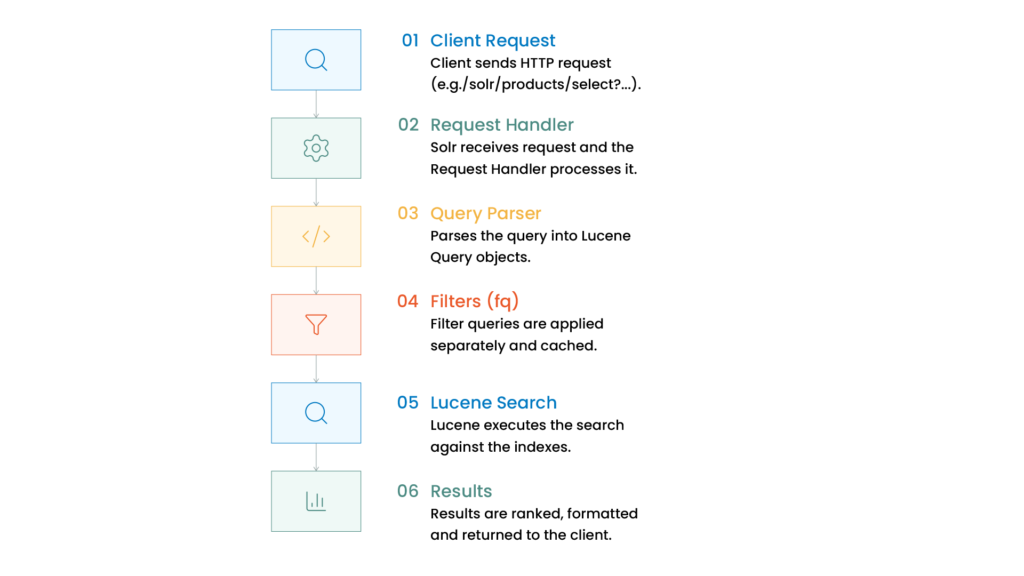
The fq parameter is especially important because filter queries are cached independently, improving performance for repeated searches.
Solr vs SolrCloud
Standalone Solr works well for development and smaller systems.
However, enterprise production environments usually require:
- High availability
- Fault tolerance
- Distributed indexing
- Distributed querying
- Horizontal scaling
This is where SolrCloud comes in.
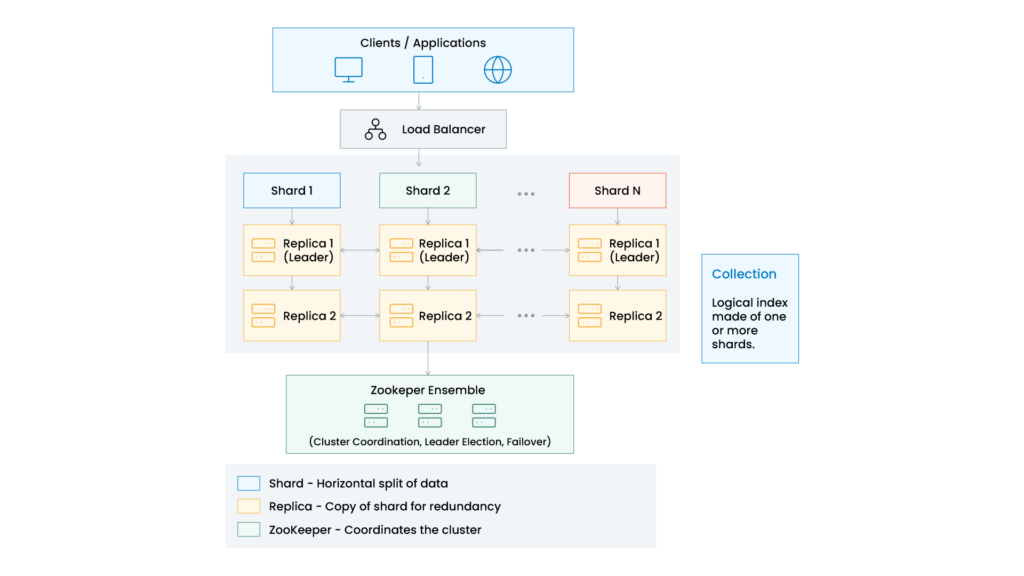
SolrCloud transforms multiple Solr nodes into a distributed search cluster.
Key concepts:
- Data split into shards
- Each shard has replicas
- ZooKeeper manages cluster coordination
- Automatic failover support
- Distributed querying across nodes
This architecture enables massive scalability and resilience.
AI features in Apache Solr
Modern search platforms increasingly integrate AI and semantic search capabilities.
Apache Solr supports AI-oriented search scenarios through:
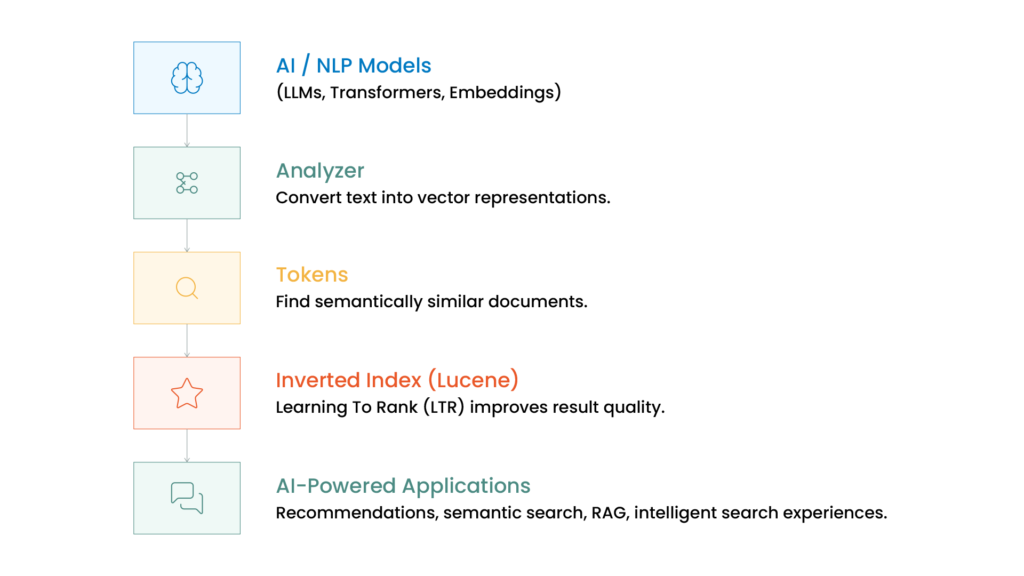
Although Solr does not provide built-in AI enrichment like Azure AI Search, it offers strong flexibility for custom AI pipelines.
Practical example: Running SolrCloud with Docker Compose
One of the easiest ways to start experimenting with distributed search is through Docker.
The following example creates:
- One ZooKeeper node
- Two Solr nodes
- Shared Docker network
- Persistent storage volumes
version: "3.8"

networks:
  solr-net:
    driver: bridge

volumes:
  zk-data:
  solr1-data:
  solr2-data:

services:
  zk:
    image: zookeeper:3.8
    container_name: zk
    hostname: zk
    environment:
      ZOO_MY_ID: 1
      ZOO_CLIENT_PORT: 2181
      ZOO_TICK_TIME: 2000
      ZOO_4LW_COMMANDS_WHITELIST: mntr,conf,ruok
    volumes:
      - zk-data:/data
    networks:
      - solr-net
    ports:
      - "2181:2181"

  solr1:
    image: solr:9.0
    container_name: solr1
    hostname: solr1
    command: solr -f -c -z zk:2181
    ports:
      - "8983:8983"
    volumes:
      - solr1-data:/var/solr
    environment:
      - SOLR_HEAP=1g
      - SOLR_HOST=solr1
    networks:
      - solr-net

  solr2:
    image: solr:9.0
    container_name: solr2
    hostname: solr2
    command: solr -f -c -z zk:2181
    ports:
      - "7574:8983"
    volumes:
      - solr2-data:/var/solr
    environment:
      - SOLR_HEAP=1g
      - SOLR_HOST=solr2
    networks:
      - solr-net
To start the cluster:
docker compose up -dOnce started:
- Solr node 1 → http://localhost:8983
- Solr node 2 → http://localhost:7574
This setup provides a practical introduction to:
- SolrCloud
- Distributed indexing
- Replication
- ZooKeeper coordination
- Multi-node search clusters
Final thoughts
Apache Solr remains one of the most powerful and mature enterprise search platforms available today.
Compared to traditional SQL search, Solr delivers:
- Better relevancy
- Faster retrieval
- Distributed scalability
- Advanced text analysis
- AI-ready search capabilities
Compared to Azure AI Search, Solr offers:
- Greater infrastructure control
- Open-source flexibility
- Custom deployment options
- Deep query customization
At the same time, it also requires more operational ownership, especially around cluster management, scaling, and maintenance.
For organizations building:
- Large-scale search systems
- E-commerce platforms
- Knowledge retrieval systems
- AI-enhanced search applications
Apache Solr remains a highly relevant and battle-tested solution.
In the next part of the Search Trilogy, we will explore Elasticsearch and compare its architecture, indexing model, distributed capabilities, and AI ecosystem with both Azure AI Search and Apache Solr.
Want to elevate your search capabilities with AI?
A robust, distributed search architecture is the foundation for next-generation applications—from intelligent semantic search to Retrieval-Augmented Generation (RAG).
Explore our AI services to see how we integrate powerful data retrieval engines with cutting-edge artificial intelligence.
Tags:Skip tags

Nemanja Marić
Software EngineerNemanja Marić is a software engineer with 6 years of hands-on experience in building robust and scalable applications. He holds a BSc in Software Engineering and specializes primarily in Java and Spring. Along the way, he had also explored C#, React, Cloud Computing, and Flutter. He approaches software development with genuine joy and a passion for creating impactful solutions by building scalable, robust, and high-quality software.
Related posts.

AI, Digital solutions, Integration
Two systems, one number, and no rule that gets it right
Danijel Dragičević• 08. Oct 2026
Find out more
AI
Can AI recover project knowledge that only ever lived in one person’s head?
Bruno Raljić• 01. Oct 2026
Find out more
AI, Industry trends
Mastering token economics: The cost of scaling LLM applications
Nemanja Vasić• 24. Sep 2026
Find out more